Monday, 10 October 2011

Out of Africa

Owing to the fact that I am no longer in Africa, any more I write under the banner of 'Dom in Africa' will be a bit of a fallacy. Therefore, I have two choices:
1) Stop writing this blog
2) Change the main blog title from 'Dom in Africa' to 'Dom Out of Africa'

I have elected to take up option #1 not because I have any problem relating this literary masterpiece/elementary narrative to the foremost Africa-based romance film of the 1980s, but just because living in Essex (or as I have said to everyone I have met over the last four months, 'just outside London') doesn't have the same excitement, vibrancy or sheer ridiculousness (although parts of Essex are pretty ridiculous, I can assure you) as travelling through ten different countries in the developing world. So I have paid a small amount of homage to option #2 with the above title, and that will do nicely.

Did you know that it is possible to survive perfectly healthily for weeks at a time without eating any fruit? Well it is. African people do it all the time - most of them live off mealie pap (cooked maize meal) and fried chicken or casseroled goat and pretty much nothing else. The odd bit of spinach, sweetcorn or green orange (work that one out) creep into their diet occasionally, but are far from being regular attendees - carb and meat seems to be all you need over here.

And during my low budget stage I did the same, just eating toasted brown bread and peanut butter (you can buy chocolate chip peanut butter over there, which is diamond), but I did have my multivits with me, which probably saved my life. They failed to save me from a certain amount of mockery though, by our friends from across the pond, who seemed to find my pronunciation somewhat amusing, but you would never catch me saying 'mult-eye-vydamins'.

I reckon I have learned as much about cultures away from Africa as I have about cultures within, so maybe this was a voyage of cultural discovery after all. Who would have guessed that Carlsberg would be the most popular beer in Malawi? Or that when American people are told to stay at least two metres away from a cheetah, they walk right up to it because they have no idea how long a metre is? How about the fact that people from north eastern Spain actually go around introducing themselves as Basque, rather than Spanish (which is largely unhelpful when talking to Africans, who barely know where Spain is)? And crocodiles are so lazy because they can go without food for three years?

My political knowledge has expanded significantly. I have learned that no Japanese Prime Minister can possibly stay in power for longer than two years, that African politicians are pretty much tribal chiefs in suits (that's not racism, it's the truth - go and see for yourself), and that Obama (despite his popularity among Tanzanian schoolchildren) needs to do an awful lot rather quickly if he wants to win a second term. It turns out the Queen is the most famous person in the world, but she is not the only queen left (everywhere from Belgium to Sweden seems to have one still, they just have even less power than ours). The British monarchy is even more popular abroad than it is at home, and we need have no fear of abolition from the antipodeans or Canadians any time soon.

Sarkozy was lucky Dominique Strauss-Kahn had some frolics with a NY hotel maid, because he would have lost the next election otherwise, and Angela Merkel is nowhere near as highly regarded within Germany as she is outside of it. Greece is truly in trouble; people aren't rioting because they are misinformed, or criminals - they just have no other choice.

And no one, not anywhere in the world, even if they are into politics, or the UK, or important political developments of the last decade, has heard of Nick Clegg. In fact, I met more people from overseas who had heard of 'The Only Way Is Essex' than the Liberal Democrats. Meanwhile, Cameron is well known and well respected already, whilst Tony Blair's image is truly marred by the War in Iraq. Dreadful shame, that.

All of this I learned from just chatting to people here and there, sometimes in the most ridiculous of circumstances - like whilst watching 80,000 naked teenage girls walk past, whilst trying to choose the dish least likely to give me food poisoning in Mozambique's only Chinese restaurant, or just during the wait for a Botswanan (to be honest he might have just swum over from Angola, but he was in Botswana) hippo to move out of the way of our canoe so we could get back to land.

What I learned about Africa was from a huge range of sources. I must have spoken to hundreds of local people, but through reading their newspapers, visiting their houses, travelling and shopping with them and eating in their restaurants I was able to gain a much fuller view of Southern Africa. A view which is very different to that of many people I met, mainly because I travelled for the vast majority of my time alone, and on local public transport. I went on few organised tours and went to no destinations with any help, security, or European accompaniment. I maintain that this is the only way to see real Africa.

And real Africa still exists very much. Granted their cellular phone usage probably exceeds our own, and Facebook is more of a social must for their youngsters than it is for you and I, but there are still huge tracts of wilderness where humans and animals live side by side, depending on each other, and everywhere you go time seems to run at about half the speed as it does in the western world.

I would love to say that Africa is full of hope, confidence and ambition, but it is not. The majority of the black people are content to just soldier on in whatever position they find themselves in, until they reach the point where they can no longer work and just succumb to the range of diseases that ravage this continent. The white people are driven to economic success, but largely have no faith in a range of political systems now unfair to them; white people cannot own land in Mozambique or Zimbabwe, they cannot enter politics in Zambia or Malawi, and are impeded from holding public positions in South Africa. Consequently, they are probably more racist, ignorant and parochial than they ever were. The white people are the ones who feel oppressed now, and given that they hold the vast majority of the wealth in most places (except in Zimbabwe, obviously) this is a huge problem.

Yet despite this, sub-saharan Africa remains an amazing place. Stunning landscapes, fantastically friendly people, and a refreshingly relaxed attitude to much of life's less important issues (such as aesthetics) make it a wonderful place to travel through. Would I ever live there? Absolutely not, but would I visit there again? There is no doubt about it, I am going back. Not now, not soon, but in time - and I am already excited to see how things will have changed.

Wednesday, 5 October 2011

One Final Shot

I'd love to say it was fired by me at this continent which has given me a fair amount of grief over the past few months, but in actual fact it was by the South African authorities.

But before we get onto that, it is worth saying a few words about my last week in the far south west corner of  Africa. Cape Town itself would be wonderful if it was just a little bit safer. It would obviously be a bit different if I was living there because a) I would not have to walk around on my own, b) I would not want to, and c) I wouldn't even consider doing so, because I would have a car. Having said that it is just such a mission getting anything done without being hassled by someone. And whereas in Malawi and Mozambique and other places they never wish you any harm, the guys who come up to you in Cape Town literally try and steal from you as soon as it becomes clear they are going to get nothing for free. I just don't like places where fear prevents people from doing as they wish; and that is one thing about South Africa - everyone, black and white, is scared.

Nevertheless, I managed to place myself back in comfortable, safe surroundings by embarking on a tremendously touristy tour with a group of American and Canadian tourists who had just been in Cape Town for a week. They were thus amazed by my stories of different countries, and the fact that I had seen many giraffes (I didn't tell them how giraffes just send me to sleep now. Ridiculous animals; they have that really long neck, yet spend most of the time eating off the ground.) and my whale-spotting ability earned me a kind of pied piper-like status. 

However, this was quickly quashed when they became annoyed at me for throwing stones at baboons and ostriches they were trying to take photos of. I told them that I was bored of baboons and hated the noise they made, and that an ostrich once stole my dinner and attempted to break into my room so I was no longer very enamoured by them either. I think it was the final straw when I told them I was bored of Nelson Mandela now, shortly before having a doze whilst we stopped to look at a couple of Zebras ("Oh my Gaaaad! Is that a baby zeeebra!?!" said one particularly overweight yank). We didn't part the trip on the best of terms.

Not that I minded - I got my required picture at Cape Point and the Cape of Good Hope and saw my first penguins in Africa, as well as a school of over two hundred dolphins, so it was all good times. And more importantly, returning to my hostel there was a good group of English 'lads' there as well as a few always-welcome cute Scandanavian girls, which meant we could properly test out the night life - supposed to be the best south of the Equator. Moreover, I was perfectly happy walking home in the early hours because there was no way I was going to ever have any money left for anyone to steal (although beers in clubs still only cost R20 - about £1.70).

So I ended my trip ridiculously hungover, just looking forward to seeing a few high intensity but low intellect action films on the plane back. I was all ready to part the country with all my nice memories (despite even being mugged by an ATM on my way to the airport, which managed to charge me R400 but only gave me R340, which clearly I enjoyed) but the immigration officials would not led me leave the country without showing me last one example of why their country is going to need an awful lot of hard work and time to get sorted out.

Being escorted to my plane by the police obviously helps, in that it means there are no queues to speak of. But it does mean missing out on duty free shopping, enjoying that last bit of leg room and a few minutes of analysing who you would like to not sit next to on the plane. But I didn't really mind missing out on those things, because it's not every day you get thrown out of a country.

I got thrown out because I had apparently entered the country illegally and overstayed my visa (I thought that was an impossible combination, but then this is TIA). Which I hadn't, it was just that the stamps in my passport have become so muddled by stamp-happy immigration officials that you couldn't actually see the relevant stamp. And the Mozambican customs just put their visa sticker over about four stamps, which was obviously helpful.

Apparently coming from Swazliand I got no entry stamp, and they refused to allow me to point to where the stamp actually was (merged with Zanzibar port authority and Namibian exit stamp) because I had broken the law and despite my assertations to the contrary, they informed me that I had no rights since I was now apparently a criminal. I think Habeas Corpus and the whole 'innocent until proven guilty' thing might not have got that far south.

I was a bit worried that I was to be refused boarding onto my flight, but had no such issues. After I had been taken to a side room (where I thought I was going to be beaten/mugged but it seems luck was with me at that point) where I was given a form to present at the South African Embassy in London (who will decide whether I am to be allowed back into SA) I was actually one of the first on the plane, which was cool.

The only real drawback from the experience is I have to pay quite a lot of money if I ever want to go back to South Africa. Which is no big deal at the moment, but there are some beautiful places I would like to go back to. But to be honest I think I'll just fly to Maputo and go from there. After all, I've apparently entered the country illegally once, so I should have no trouble doing it again.

Thursday, 29 September 2011

A Different Kind Of Sharking

Dah-dum, dah-dum...yes there is a huge Great White Shark powering its way towards me, dorsal fin poking through the surface of the water like a great triangular warning sign. But it's ok, because by all intents and purposes I should be in a large boat which is resistant to all of these kinds of things, too solid to be worried by anything as small as a fifteen foot long, two tonne shark. Oh no what's that? I'm actually in the water less than a foot away from this beast as it crashes into the cage in front of me. Slightly nervy at first, I'll tell you that much.

To be honest, it wasn't really that bad. More fascinating than frightening. Just to see these epic fish up so close and to experience their awesome power is something else. Their teeth are like shards of ivory just rammed into their gums and their mouths are so massive I'm pretty sure they could swallow me whole (I've lost a bit of weight recently, you see), and if not me they could definitely swallow your children.

Despite being told about how agile they were - apparently that is the only advantage they have over Orcas (killer whales), who are their only predators; that and the fact that Great White Sharks just leave their children to die if under attack - they all seem quite cumbersome to me. Charging in to grab some cheeky tuna heads left on the surface of the water by the crew, the sharks seem to just charge straight through (at 20 knots, apparently) and then smash straight into us. Which rattled me a bit, I don't mind telling you. It rattled the cage slightly more though.

Shark cage diving is just as contrived as every kind of wildlife viewing. It involves getting in a big boat with lots of other tourists, motoring out across a bay, lobbing a big metal cage in the water and a couple of bleeding fish heads into the water and then waiting for some sharks to come. When the shark comes up you jump over the side into the cage, the man with the fish heads puts them right in front of the cage and you try to avoid filling your wetsuit with all kinds of horrible things as the shark comes within a hair's breadth of your position. It is good fun, and the only way to see these beasts up so close is by being in the water with them. It was cold though.

The place I did it was called Gansbaai, funny because it is pronounced 'Hanssbye', being Arikaans and all. I was staying in Hermanus, which has the most whales chilling out under its cliffs out of anywhere in Africa. So I was just walking home from Pick'n'Pay (the Tescos of SA) when I spotted about six whales just languishing in the bay. I stopped and ate my pre-pack cheese, ham and tomato sandwich there, just watching mum and baby whales having a nice time in the choppy water. I had a nice time, too. Though my photos were dire, the whales being mostly underwater and all.

And now its Cape Town until the end of my trip. The Lonely Planet says it is easy to fall in love with this place. I will fall in love with it as soon as I stop getting people coming up to me threatening to knife me, which happened twice today. And I am yet to walk home tonight yet. But I suppose that is my own choice in doing things on my own and refusing to get taxis anywhere.

On a lighter note, I went to Mandela's old prison cell today. It was smaller than I imagined; 18 years is a long time to spend in a room the size of a kitchen cupboard.

Tuesday, 27 September 2011

Full Circle

Back on the mean streets of CPT. Well, it certainly feels like Compton in places anyway (in case you were wondering, Compton is the birthplace of more platinum-selling artists than anywhere else in the world) but really Cape Town is nowhere near as bad as that dark corner of South Central Los Angeles. Although I did do my now habitual thing of arriving in the most dangerous part of the city - Cape Flats Metrorail Station - alone at 9.30pm with no real idea of how I was going to reach my hostel. 

But it was no big deal really - I survived doing it in Jo'burg which has a bit of a reputation, whereas Cape Town is known by all to be one of the safest places on earth to be at night - the Zurich of the Southern Hemisphere. That's as long as your locked up in your City Bowl Penthouse.

Which I was by 10.00, which allowed me to get a massive case of deja vu. Not only was I in the same place I had started my trip back in June, I was also being confronted by some religious nutter once again. Something I neglected to mention when writing about Cape Town a few months back, but the first person I met whilst starting my travels of this mega continent was a God-fearing mentalist who was hiding in backpacker's hostels to escape the realities of life.

So it was to my surprise and (feigned) delight that within five minutes of re-entering a dorm in Cape Town I found myself in an argument with some bloke who accused the City of London of hatching a conspiracy to subjugate the entire world's populace by collapsing the financial system again, having just caused an earthquake/tsunami in Japan, the tropical storms on the Eastern Seaboard of the USA and are now somehow leading a comet to crash into Russia/China. But it's ok, everyone, don't worry - because out of the ashes of this crisis God/Jesus will come again, cast out the devil and we will be saved.

Except for me. We got into this conversation after the usual questions of, 'So what will you do when you go home?' To which I normally answer, 'Well, get a job probably. Seems to be the done thing.' At which point they ask me what I want to do, and I'll say something like, 'Most jobs are in London, so probably a generic city job or something.' At which point I was branded a Luciferian, and our quarrels began. Yes, Barclays/HSBC/RBS/HBOS/Lloyds/Citi/Every other bank you can think of are run by the devil, in case you were wondering. And they are going to destroy the world unless we do something about it.

Oh dear, I'm boring myself talking about this. I was so bored at the time that I ventured out on to the Cape Town streets under the pretext of getting something to eat, only to find I didn't really want to be out on the Cape Town streets that late at night to I went home again. Still, it was better than listening to the ramblings of a madman.

In other news, my spending has reached start of the trip levels owing to an addiction to Dairy Milk Biscuit (never seen it in the UK - it is diamond, I tell you) which my mugging experience did nothing to put me off of.

Slightly more interesting is the fact that I did the highest bungee jump in the world the other day. 216m off the Bloukrans Bridge, at Storms River on the Garden Route in South Africa. I'd love to say it was amazing, but it was all a bit dull really. The best part was the music they played before we jumped - throwing some shapes to a funky house remix of Dennis Ferrer's 'Hey Hey' whilst two metres away from plunging to my death/an adrenaline explosion is something I won't forget for a while. But all in all, I need to get away from these high octane activities for a while. I think I'll leave them until I've worked a dull job in an office (where my boss will be the devil) for a year or so, then I will appreciate these things a bit more. Got great white shark diving coming up - we'll see how that goes.

Only a week left here now. A lot to cram in, but then even more to do when home.

Saturday, 24 September 2011

'HIV - To Make You Feel My Love'

This desecration of the title of one of my favourite Adele songs annoyed me just a little. As much as I like to see that a British artist is doing so well in a different continent (her most recent album, 21, is just as big here as it is in every other part of the world), I don't like to see it graffitied onto the side of a school in such a way that pretty much somes up the nonchalant attitude people have to HIV. But then I suppose if half the people in your village have it, it must be quite easy to not give it a second thought. Or not. Different world this, really.

And it is different. Travelling along the south coast of SA is like walking through a tunnel that has been hotboxed by a rasta who is trying to burn his ganger supplies before the police come. You can't move without weed being in the air somewhere. I went on a cheeky hike in the jungle (yeah I didn't know there was a jungle here either, but there is) and our guide had to have a joint at 9.00 in the morning to give him the energy to climb up a big hill. It reminded me of being in the Himalayas where our sherpas used to chainsmoke cigarettes they had named 'stamina sticks'.

I have declined to add marijuana abuse to my increasing list of vices, but the extent of passive dagga inhalation might be the reason for these epic headaches I keep getting. Or maybe that's the combination of too much beer and a diet of bread, jam and 'polony' - some cheap but nasty processed meat they all eat here.

Anyway being down here is like being at home. On my way from East London I travelled through Colchester, which was odd. It is Britain's oldest recorded town, but the only sign of any Romans I could spot in this Colchester was a nice straight road. Except this road had roadworks and loads of potholes, obviously. And then in Port Elizabeth I stayed in Southend. It was even on the seafront. Didn't have a pier though, nor any rude teenage girls walking round in belt-length skirts shouting alcohol fuelled obscenities at all and sundry. In this particular Southend they don't really say anything before they stab you.

So a long time on the road also brings out a few experiences. Like getting a ride in a local minibus where the area's pimp was giving his morning payout to his girls. I wondered what was happening when we stopped every five minutes for this guy to give young semi attractive girls wads of cash at the side of the road, but when I exchanged a puzzled look with the person next to me, she explained that the girls were getting paid for, 'The work they did last night.' So that was a novel experience. Won't see that again in a hurry, I'll warrant.

I don't know whether having a pimp in the car means the driver has to drive like an imbecile, but he did. 160kmh was the fastest we went down a 15% decline, and that was too fast for my liking. Especially as I travelled through an area where twenty people had died on an identical bus the day before. It's a risky business taking local transport, I'll tell you that much. I did have to be held back by three fellow passengers the other day after I got so annoyed with one particular bus conductor trying to charge me white man's rates. Not really the way to win friends in a new town, but it did annoy me. And he was definitely smaller than me.

Apart from that I am mastering the Xhosa language now. By mastering I mean I can say 'hello' - which is 'molo', and I can only say that because it is the only word without any kind of clicking sound in. It's a ridiculous language and I'm glad everyone speaks English. Mind you I'm in a town where they only speak Arikaans now and that isn't much easier. The people who speak it are all white and as a result have significantly less patience. And don't like it when I refer to them as either 'saffers' or 'boers', pronouncing the latter 'bore', as in 'Anglo-Boer War'. Which we won after putting all the women and children in concentration camps. They weren't too happy when I brought that up last night. But as I lied to them earlier and said I partly agreed with aparthied they didn't mind me too much.

Anyway I'm doing the highest bungy jump in the world tomorrow. After all, it's not as if I have anything better to do.

Monday, 19 September 2011

The Most Developed Country In Africa...supposedly

The problem is, I can't really see South Africa moving forward in any way. It's just a ridiculous place through and through. Yes it's beautiful, and things do seem to work here - in general, but nothing is improving with the big issues that actually matter.

Like HIV. The government seems to be racking up the education and the access to contraceptives and healthcare, but the populace seems determined to resist it. Young people still don't go for tests - even though they are free, they still don't use condoms - despite the fact that they are everywhere, and they still don't tell anyone even if they do have the disease. They just go on being promiscuous, spreading this plague which is wiping out an entire generation here.

I'd like to say that my views on this are only a microcosm of society, and that broadly things are moving forward. But the truth is, I have been to quite a few places now and everywhere is the same. South Africa is no better than other countries in this regard, as with the likes of tribalism and a conservatism which makes the right wing of the Tories look like proponents for a socialist revolutionaries.

People are too focused on the cure rather than on prevention. And we all know which is better than which.

It does not help that everyone in the country is racist. Or 'racialistic' as some boer tried to call it, whilst he explained how all black people are stupid. They don't trust the black population (you do kind of understand why when since Mandela things have kind of gone downhill somewhat, especially for the whites), and as a result there are two sectors of the population, who don't mix. Therefore there is no free transfer or exchange of wealth or property, and thus very little social mobility. It is messed up.

You know that things are wrong when Oxfam don't want to know anymore. They moved out last year, so did VSO - the main organisation for western volunteers. But then, white people can't own land in certain parts of the country, and they can't be employed in others. And if the only people with the required skills are white, what are you supposed to do?

It is just such a shame. At some point this bubble is going to burst - which seems soon, based on the current political strife (the ANC, the only real political party here, is about to implode), and when it does, I fear for South Africa.

Not that I'll be here then. I'll be working some boring nine to five in an office five minutes from the Isle of Dogs. But I would like to come back here some day, and see some of these things sorted out.

Tuesday, 13 September 2011

Fat Africans

There are a lot more than Comic Relief would have you think. In fact, every white South African over the age of fifty is nearing obesity, and among the black population most women who have given birth are packing a few extra pounds here and there.

I feel the need to talk about this because firstly I find it quite interesting, and secondly it is much more light hearted and less worrying than talk of AIDS, muggings and apartheid. So fat Africans. How do they get that way?

Essentially, because food costs so much. Fruit and veg costs more than in Western Europe, and this is in a country where people earn about ten per cent of what they do back home. So they can't afford healthy food. What do they eat instead? Just carbs, carbs, fat and more carbs.

The main staple of sub-saharan Africa is mealie pap, maize meal which is boiled in water to create something a bit like polenta but drier and more solid. Apart from this though, they just have fast food. African style.

The 'Kota' is something I would like to introduce to the UK. It is a quarter of a loaf of bread ('Kota' being pronounced 'quarter') with the inside taken out and it being filled with chips, cheese, egg, burger, a variety of sausages and anything else that fits in - often a cheeky bit of mince and mash too. Enough to fill you up for two meals - and they cost a maximum of 15 Rand - 14p.

Not the healthiest things in the world, and between that, popcorn (called 'kip-kip') and various kinds of crisps Africans are getting fat. Especially as they detest walking. The TV would have you believe that children walk miles and miles to school and for water in the morning. Not so. They get the bus outside their house or at the end of the road and then get stressed at the driver when he pulls up five metres from the school gate.

Mature African women hate walking even more. Not surprised though, they have such bad backs from carrying heavy stuff on their heads all the time that they kind of waddle, sticking out their huge backsides for everyone to collide with whilst they move at snail's pace through every environment.

Nutritional education didn't reach here. And seemingly nor did sex education. The President, Jacob Zuma, is famed for thinking it is fine to sleep with HIV positive women as long as you shower straight after sex, and the newly appointed Cheif Justice, Moegoeng Moegoeng (real name, honest - pronounced Mohweng Mohweng) believes that there is no such thing as rape in the home. These are the two individuals with the most influence over the law. No wonder South African politics is imploding.

But on a lighter note, the South African murder rate shrunk by 6% in the last year, latest figures show. Only 19,500 were murdered last year. In a country of less than fifty million. That's quite a few, in case you were wondering.

Dangerous? I smile in the face of danger (that's a direct quote from the Lion King, it's not actually how I feel. I saw the Lion King in 3D the other day, feeling like I was in need of a proper African experience).

So there are loads of Fat Africans, probably proportionate to the number of fat Americans in the US, and the political situation is dire. I will offload some more useful tidbits sometime soon.

Sunday, 11 September 2011

When I Got Mugged


And I was mugged. I felt like a proper idiot afterwards. Humiliated, in fact. But then looking back on it, I’m not sure there is much I could have done differently. It went something like this.

Being this long in Africa and not having any trouble I had begun to get complacent. More importantly, being in Soweto and encountering only nice people who couldn’t wish me any harm at all had meant I lowered my guard. I stopped suspecting people, and didn’t think that anyone would want to harm me or steal from me. Seems I was wrong.

I was on my way home from work (I’ve been volunteering at a community project for families affected by HIV/AIDS for the last two weeks) in a taxi (they call local minibuses taxis here for some reason) when it pulled over to pick someone up. I was sitting in the front, next to the driver, eating my bar of Cadbury Dairy Milk Whole Nut that I had bought as a treat – having surrendered my no snack policy for the time being. I was so absorbed in my world of milk chocolate delight that I failed to notice the group of five black twenty-somethings dashing towards the taxi.

I thought nothing of it, I regularly have people come up to me and wanting to shake my hand. These guys seemingly wanted some of my chocolate bar. And were so determined to get it that they opened the door of the taxi and literally started grabbing it. I went on the defensive, guarding the last few chunks of this former bastion of English (now American, unfortunately) confectionary against everything they could throw at it.

However, it seems that the Dairy Milk was not their main goal. Whilst four of them went for the chocolate bar, mugger #5 darted his hand into my pocket and grabbed my wallet. He then dashed of at the speed of light with a big smirk on his face (a smile I will remember for a long time) whilst the four others crowded the door so I could make no move to follow him.

Not that I would have, of course. Firstly, I was wearing flip flops, which are impossible to run in. Secondly despite how angry I was, I could not hope to overpower five guys with my bare hands, against whatever they had on them – knives at the minimum. Thirdly I was paralysed by shock. I couldn’t have done anything even if I had wanted to. Very much like when some drunk guy punches you out of the blue – it takes a few seconds to comprehend what exactly has gone on.

So I sat there whilst he ran away with my wallet. The other guys stayed until he was an uncatchable distance away before they too made their exit, and I was left sitting there like a lemon. ‘Not ideal,’ I said aloud, finally. The other people in the taxi, it must be said, were expecting a more invigorated response.

The taxi driver told me that if I went to the police they would shoot the guys for me. I didn’t really want that, nor the hassle that it would entail. One of my favourite sayings in the world is, ‘You can’t polish a turd,’ and that is what I applied to this situation.

So what did I lose? Not much, really – apart from my dignity. My wallet contained about R300, which is around ₤25, and one debit card, which was cancelled within an hour. So financially, it was no great loss.

Sentimentally, slightly more so. I had in my wallet a collection of notes I had obtained from all of the countries in there – there was everything from Namibian dollars to Mozambican meticais, which I had been saving to keep at home for a souvenir. One consolation is that the thieves would have glanced in my wallet and seen this huge wad of notes there and thought that they had hit the jackpot. And then they would have delved slightly further to find that 5,000 Zambian Quacha is worth less than $1, and 3000 Tanzanian shillings is worth little more. And no bank would exchange them, anyway.

Losing the wallet itself was a bit sad though. Admittedly it only cost me ₤1 (or 80 Rupees, in the currency in which I bought it), but I have had that fake ‘Genuine Leather Lacoste’ wallet which I spent an hour haggling for on the streets of New Delhi for four years now, and had become quite attached to it. I carried it around with me in Africa because I pretended it had no value – financial, anyway – so I would not mind it going missing. But in truth, I am more sad about its loss than I would be a $500 Louis Vuitton.

Still, what is done is done. I have been mugged, so I can tick that box. I still haven’t been violently assaulted or got any kind of disease so I’m not doing so bad for nearly three months travel through the world’s poorest continent. The really ironic thing about the whole situation is that at eight o’clock the next morning I was giving a presentation at the regional police station, shortly after which I was speaking to the Chief of Police, who asked me how safe I was finding Soweto.

‘Oh it’s fine, I feel perfectly safe here,’ I lied. The last thing I wanted was to start a witch hunt in the black capital of South Africa because a white guy had been stupid enough to have been mugged for ₤25.

Tuesday, 6 September 2011

'Gandalf my friend, this should be a night to remember!'

Sorry for the Lord of the Rings quote, but it was the only method of appeasing my craving to watch my favourite fantasy film triology. But any, it really was a night to remember. I only wish I could have taken my camera out without the fear of getting it stolen, because it would have been mighty cool to have some pictures of the evening. My favourite mental image of the night being the sign outside all the bars saying 'No Guns'. Nothing saying you're not allowed knives, ice picks or crowbars though. Although it seems African people don't even need those to induce the propensity for violence - a broken bottle will suffice.

Anyway I went on a night out in Soweto. Big deal. Apart from the fact that within five minutes of being at the first bar I had seen three fights. Which I don't think is the worst I have experienced - I have been out in Southend a few times, after all.

Despite the fear that I was going to return home a eunuch, it was one of the best nights out I have ever been on. The location was obviously a key reason for this. Kind of what I imagine it to be like when the Rio de Janeiro carnival makes its way through parts of the favellas - this was the start of the party season (the first weekend of September, when it becomes warm enough for the locals to begin to party outside), and now every Friday and Saturday night there will be massive bashes on every street corner.

Essentially a man with a gazebo comes along and puts it over a road. Then a man with some decks comes and puts them under one end of the gazebo. Mr Amplifier then comes along with a couple of giant subs, and finally some chap with a bit of mixing ability comes along with a few records and starts pumping out some rock solid funky house. Which sounds sick, just so you know.

Like any good party, it only got started after midnight, leaving a small amount of time to visit some other establishments prior to getting one's groove on. The only trouble being that they were too far apart to be able to walk between them (Soweto is a city of over five million people), so we had to drive. No problem. Except the guy driving was equally battered as everyone else. And seemed determined to carry on drinking even whilst driving.

'Are you allowed to drink whilst driving in South Africa, then?' I asked rather naievly. 'Hell no man!' replied Lil Wayne's long-lost cousin, 'You aren't allowed to drink in public at all!'

What followed was a comprehensive briefing on what to do if we saw the police. If we were in the car we would all throw our beers out the window, at which point we would race off down the nearest small side street and hope to escape them. If we were walking we would wait for someone to shout, 'drop!', at which point we would drop our beers and run to the nearest fence or wall, jump over it and then sprint til we could sprint no longer, and then get inside the nearest building possible and hide under a bed or in a cupboard. No joke, this is what they told me.

So this brings the total number of life threatening dangers for the day up to 3:
1) Being subject to GBH
2) Dying in an alcohol-related RTA
3) Being beaten to death by the police/some kind of angry fellow prisoner with a hatred of white guys in a local jail.

I would now like to add #4 to that list. HIV/AIDS.

This was the closest I have come to it. In a community like this most people know who else has it and who does not. Obviously I was subject to a fair amount of attention, both male and female, due to being the only white guy at a party of over a thousand. And I have been dragged off by semi-drunk girls who only want one thing (not always unwillingly, it has to be said) before. But they have never been this forceful before, and nor have they been HIV positive.

So when four girls have a hold of me and are dragging me towards one of their houses, with my resistance seeming futile, I was a bit worried what I might be getting myself into. And this was confirmed when five of the guys I had gone to the party with came along, grabbed the girls and literally threw them onto the floor. Apparently, these seemingly lovely young lasses would want nothing better than find a nice white young man and give him the gift they had been carrying around since birth. I decided that on this night, celibacy was the best option.

But aside from these dangers, it was wicked. Obviously black people are better dancers than white people, so there were some awesome moves going down. I obviously introduced them to the concept of throwing a few large shapes, but their foot and hip work was awesome - and the booty shaking from the girls left me gazing in wonderment (until some guy came and started on me for staring at his missus - but you get that anywhere, to be honest).

So combining three of my favourite things - music, excessive alcohol consumption and the possibility of meeting new, exciting people and there is a very good night. One that will be hard to match.

Friday, 2 September 2011

Soweto

I spent a while trying to come up with a crafty title for this entry, musing over the likes of, 'No more dangerous than Romford on a Friday night,' and 'History in motion', but I thought that just the simple title has as resounding an impact as any intelligent literary slur I can come up with.

Because this (Soweto, south west of Johannesburg) is a incredible place. Arguably the place where the downfall of apartheid began, it is definitely the location of its orchestration. Student protests here (all from the black community) in 1976 led to a heavy handed response from the (white) police force, with 23 people being killed. This led to widespread condemnation from the international community towards the government, and brought into the light the situation in South Africa. Though it was not for another twenty-four years that apartheid was ended (or 'independence' as the black community refers to it), the 1976 uprising was the start of concerted action from the black community, most notably the ANC - who were centred in Soweto - and led the rise of the black protest in South Africa.

As a result, I feel quite humbled to be staying here; staying with a local man who lives one street along from where Nelson Mandela and Desmond Tutu both used to live, and only a hundred metres from the route of the original protests which led to the uprising. The man I am staying with has lived in Soweto throughout his life and thus through these periods of political strife and change. He is as a result one of the most accepting and friendly people I have met, being of the same ilk as Mandela (or Madiba, as he is called here). He believes in extending the hand of friendship to as many strangers as possible, because only through people understanding places for themselves can they recognise the true face of a society and culture.


And it has worked with me. I am the only white person in the village. At the project where I am working everyone else is local, on my hour-long journey to work I see only local people going about their normal lives. Yet the guidebooks tell you to be more careful here than anywhere else. This is labelled as part of the 'dangerous jo'burg' section, where I should not walk around on my own, and should not be out at night at all. Yet all I encounter on my wanderings (which I obviously conduct on my own), aside from the customary stares because of my skin colour are people calling out to me, 'Saobona my friend, welcome to Soweto!'

Something I have encountered throughout Africa is local people being unable to understand white people walking to places. It seems the white residents of these countries drive everywhere, and only the poor people walk. Obviously I have managed to degrade myself to 'poor' status (too many bungee jumps, skydives and scrumptious meals I think), and thus I walk everywhere possible. Normally the locals just look at you and ask if you are lost, but in Soweto they actually ask if you want a lift. It seems people here are determined to overturn the image of this place as somewhere white people cannot go - and they are doing a good job of it.

Staying with locals obviously means living like one. Which means my fruit and vegetable intake has been cut to one-a-day, the main food here being a 'Kota', pronounced 'quarter', because it is a quarter of a loaf of bread filled with unhealthy things. Such as chips, sausage, egg, cheese, ham and whatever else they have on display. But they cost max R20, normally around R10, which is less than GBP1. Local living also means there is only a cold shower, no toilet seat and no working lights in the room I am staying in. But I cannot complain - the generosity of the people to have got me this accomodation when I could have been a chav from Basingstoke rather than a fairly well mannered (at times) person from rural Essex.

And I do not know anyone else who has had such an experience. Spending the mornings visiting and trying to address the needs of the guardians of AIDS orphans, and spending the afternoons trying to improve the quality of life of the orphans themselves is something that is richly rewarding, and is defnitely an experience I will not get at home.

I seem to be lacking the amusing anecdotes with this entry, but that is because the only thing funny about this place is the bumbling Englishman walking through town expecting to feel intimidated, and frightened but instead only feeling welcomed and impressed. Obviously Soweto is not perfect, and there are still huge problems here. But it is the finest example I have seen of an economic, social and industrial powerhouse created by black people entirely by, and for, themselves. This place has promise, which hopefully, in the not too distant future, will spread to the rest of the continent.

Monday, 29 August 2011

The Kingdom

How many virgins can you fit in one field? Well, according to the organisers of the Umhlanga Reed Dance Festival in The Kingdom of Swaziland, over 80,000. I don't know if there were actually 80,000 there, because I lost count after two hundred. But there were definitely lots of them there. In fact, there were virgins as far as the eye can see. And they were all half naked.


Now you might think that for a virile young man such as myself that this would be the perfect outing, especially with my camera in one hand and no chance of reprimand in the other. But I didn't really enjoy the ceremony. There were girls there as young as nine, and I'm not too comfortable around naked girls who haven't even reached their teens (or ones slightly older than that, to be honest). I took a few photos, obviously (rude not to), but these were from afar or behind wherever possible. Although the latter also brought some uncomfortable viewing.

The purpose of the festival is ostensibly to allow the King (the seemingly omnipotent ruler of Swaziland) to choose his next wife, so all the girls in the Kingdom who are yet to be tainted by manflesh come together and present themselves to the King. And he then choses one of them to join his harem. But to me this seemed a bit farcical.

I don't know how on earth he is supposed to choose one girl from among the masses spread out before him, and I also don't know how he is supposed to be certain that their maidenhead is still intact. It seems that this whole aspect of the festival is a bit artificial, and the lucky lady is chosen prior to the event. Instead, the event has come to be a time when the young girls of the nation come together to celebrate their virginity, which is supposed to be maintained until marriage.

They see this as culturally significant, but obviously from a Western observer of a country where the HIV infection rate is over 25% the fact that girls can be proud of not sleeping around should help to prevent the further spread of infection. How much effect their being proud actually has, no one can be sure, but every cultural aspect should help, as tradition is one of the most significant reasons for the astronomically high rate of HIV/AIDS.

However, just because I felt uncomfortable taking photos, it does not mean that others didn't. This was a tourist fest beyond my imagining, and it made me think of what it must have been like to stand in front of Buckingham Palace waiting to catch a glimpse of William and Kate (or 'Catherine' as she seems to be called now) having a cheeky smooch. Everyone literally fighing over the most opportune photo taking point, and those with the biggest cameras somehow thinking that gave them the right to be at the front of the crowd. 'Excuse me,' I said in response to one such excuse for a rather hard shove, 'but I am taking mental pictures.'

I do not like to stereotype nations or races, but there were two very prominent cultures on display in the tourist area of this spectacle: The Japanese and the Germans.

To be honest, I don't have a problem with the Japanese being there with their cameras. They make the best cameras and they take so many photos that they must be good at photography - and I suppose that is why all the official photographers hailed from the Orient.

But the Germans...grr...

As I say, I hate to stereotype nations - I have met some wonderful German people since being out here, some of my favourite, in fact. But I have also met some I absolutely detest. The kind that will get up at 5am to put their towel on a sun lounger by the swimming pool. They also think it is their god-given right to have exclusive access to the best viewpoints from which to stick an 8ft lense on the front of their semi-expensive SLR and take too many photos of a few virgins who just want the chance to be looked on by a fat man in a cape with some feathers in his hair (Mswati III, to you and me).

It wouldn't be so bad if they weren't all male and over fifty. When they decide to take a picture on 30x zoom of a twelve year old's breasts they have gone too far. And obviously I know exactly what they were taking pictures of, because they put their camera right in front of my eyes whilst taking the picture, so I am unable to anything else but their perverted media.

But this failed to ruin Swaziland. The people are lovely, the public transport incomprehensible (it costs 4 Rand - 35p - to go anywhere, be it 200m or 10km) and the scenery is fantastic. Nevertheless, my stop there had to be fleeting, because aside from watching parading virgins, there isn't all that much to do.

So I decided to come to Jo'burg. Which is fine. It is perfectly safe if you stick to well populated areas, travel around in groups and make sure you are in your accommodation before dark.

However, by the time my bus left Swaziland it was 1.30pm, and it is a 5-6 hour journey to Jo'burg. So naturally, I arrived in darkness, on my own, looking for a hostel in a rather deserted part of town. I have been in such situations before, and they were fine - but they were not in the city with the highest violent crime rate in the world.

Nevertheless, I still felt able to get annoyed at the taxi driver when he overcharged me (you wouldn't pay a fiver for a five minute taxi ride even in London), so perhaps that gusto saw me through to safety. Although tomorrow I'm off to stay in Soweto for a while. Heard of it? Arguably the place where they hate white people the most in the entire world. Lucky I'm slightly tanned then - I should be fine.

Saturday, 27 August 2011

Civilisation

I like being in a country that works. When I say that, I don’t mean to condescend the other countries I have been to. They all work too – in a fashion.  Things just take a bit longer, they aren’t as high quality, and normally end up costing about fifty per cent more than you thought. But then that was Africa. This is not.

Obviously the main difference between South Africa and the likes of Mozambique, Malawi and Tanzania is the number of English speakers and, to be more blunt about it, white people. Now I have seen enough of the ingenuity, practicality and pragmatism of the Bantu people (black Africans) to know that they are by no means unintelligent or uneducated, and so I am slightly puzzled by why South Africa is so much richer, more developed and civilised then the rest of Africa. 

But maybe it isn’t any of those things – maybe it just seems like this to me because South Africa seems more like Western Europe, and so I associate it with modernisation and development. Maybe the other nations are at a similar level of social evolution, they have just taken a different path. And maybe the white population of South Africa, through holding the vast majority of the wealth, is holding South Africa back, making it try and become the England of Africa (Namibia is Wales, Botswana is Scotland and Zambia/Zimbabwe are Northern Ireland and Ireland, in case you were wondering. Oh and Lesotho is the Isle of Man and Swaziland is Jersey). Africa should perhaps find its own path, away from a Western-imposed (the likes of Anglo American and BAT run things here) model of development.

That said, I like going into a shop and knowing how much something is going to cost. I like having electricity twenty-four hours a day, and hot water too. I like a fourteen seater bus being for fourteen people (even if it is being driven by a drunk Aretha Franklin fan), and I like not having to pay through the nose for a visa.
More importantly, I like the countryside. The palm-fringed beaches of Mozambique are far behind. Mpumalunga (seriously, that’s what it’s called) in the north of the country is filled with rolling hills, dense vegetation and stunning streams, rivers and waterfalls. This travelling lark works on recommendation, and I was recommended mountain biking in the Blyde River Canyon, up to somewhere called ‘God’s Window’, which gave me the chance to experience this first hand.

‘God’s Window’ – that’s a bit of a pretentious name isn’t it? I thought that myself, until I saw it. There are actually two God’s Windows – the less good one close to the road with all the tourists (including the local kids on a school trip who feel the need to stand at one of the world’s most outstanding areas of natural beauty and blast out a Pitbull-Soldier Boy remix from their cellphones), and then the one that you have to cycle for two hours up an old logging track to get to. I did both. Guess which was better?

The first one is just a viewpoint, overlooking about fifty kilometres of wonderful countryside. A slight haze hangs over the valley most days, but it just adds to the splendour of the sight.


However, the second one – the ‘real’ God’s Window to the locals – is actually a large, upright flat rock with a square hole in. Like an actual window. Look through it and the view is even better. Perhaps because it is higher, perhaps because it is framed by this natural feature. Perhaps because you have had to sweat like a pig in order to get there, and when you do there is no one else in sight.


I think I spent about an hour there, just listening to a few tunes on the old iPod (which is working well, in case you were concerned) – Sigur Ros if I remember rightly, eating a tuna pasta salad I had concocted the night before (no, I haven’t lost my culinary skills yet), and generally enjoying being alone. I hope God wasn’t trying to look through it at that point, because he would have had to peer over my shoulder.

Anyway after that I went kloofing, which the Afrikaans version of canyoning. Which means that it is generally more aggressive (like all the Afrkiaaners) and that you don’t get a choice as to whether you are jumping into the waterfall – because otherwise their big dogs just chase you in. Still, once in the waterfall, it’s nice to be there. The Afrikaaners also enjoy taking pictures of you whilst looking ridiculous, and then commenting on the picture in Afrikaans which they know you can’t understand. Still, a nice day out.

And now I am in Swaziland, waiting for the Umhlanga, the Reed Dance Festival. It is where 60,000+ virgins in the kingdom come together to dance with reeds on in front of the King, and then he chooses one of them (the youngest are twelve years old) to join his harem. Sounds quite spectacular – we shall have to wait and see.

In the mean time, I am in the nicest hostel in the world. No jokes, this place is stunning. And it only costs £9 a night. Check out the view from my window - not bad, not bad at all.


Saturday, 20 August 2011

Into The Light

More paradise here - Tofo Beach, Mozambique. I think I'm going to make this the last white sand beach with lovely warm water and palm trees for a while, because they are getting quite boring. And I haven't seen an elephant for a couple of weeks so I think it's time to hit Kruger National Park.

In the mean time, I wanted to comment on a couple of milestones. Whilst on the aforementioned hellish journey there was a brief moment which was rather nice, when we spent half an hour or so travelling through the Zambezi Delta. And then got to a massive bridge over a massive river with the sign 'Zambezi' written on it. This is significant because the first time I crossed such a bridge over this same river was in Namibia - six countries ago.

Since then I have encountered the Zambezi in a number of ways and names - getting smashed and dancing like a berk on the banks of the Okovango, cruising down the Chobe watching massive herds of elephants, jumping off a bridge with just a rope tied round my ankles over Vic Falls, white water rafting on the Zambezi rapids, and then finally driving over it in a bus that stank of vomit as the sun was setting. Quite a journey - and I didn't get bitten by a crocodile once.

The next milestone to comment on concerns two possessions of mine that I did not think would make it this far. One is my yellow fever certificate (known as my 'Namibian Health Passport'), the other is my Andrex tri-ply.

When I get home I will take a picture of my yellow fever certificate. The only reason I can actually give for how I have been allowed into so many countries with it is that this is Africa. Where they seem to accept a photocopied dog-eared piece of paper with the words 'yellow fever' written in a doctor's illegible scrawl followed by his signature, which has got rumpled, crumpled and dampened more times than I can remember. But it's ok - because it has the words 'Namibian Health Passport' written on the front. So it must be legitimate....because Namibia has such a strong reputation in the field of healthcare.

So why NHP over NHS? Well, I didn't really plan to go to Tanzania. And then it kind of happened, but Tanzania has yellow fever, and I didn't have a vaccination - so I did what every intelligent, health conscious, western traveller would do: I rolled into the nearest medical centre and asked for an injection. Only this one happened to be quite close to the Namibian desert. In fact, you could go as far to say that the centre was in the middle of it. Still, the fact that after having the jab in my derriere the fact that I couldn't sit down for an evening didn't bother me too much. This was because I had the magic piece of paper that would get me into every further country without any trouble (as long as it was accompanied by a number of small green pieces of paper with a picture of a certain federal reserve on the back).

And now my yellow fever certificate is more of a morale booster for me than haribo or dairy milk could ever be. Crossing African borders can often be stressful, especially if it is into Mozambique, when the man decides that on that particular day a visa costs US$80. At which point I protest, saying that the embassy told me it was only $25, at which point two of his colleagues look up at me and the American bloke behind me whispers in my ear, 'Just pay it man, it's not worth it.' I was unhappy, but was sufficiently buoyed by the way in which they accepted my yellow fever certificate without question that I soon got over it.

Obviously the Namibian Health Passport has its sternest test to come, when I try to get into South Africa in a few days time - South Africa being a proper country and all.

Now, onto the Andrex Tri-Ply.

In terms of toilets, Africa is better than I was expecting. Having travelled in Asia, where the toilet seat is the air immediately above a hole and the toilet paper (henceforth known as bog roll) is your left hand, I was expecting similar standards here. However, it seems Cecil Rhodes did a better job than Robert Clive in instilling western standards and as a result most toilets have seats, flushes and, often, bog roll.

It is really only the worst toilets which don't have any proximate wiping device, and it is in these situations that many might despair. They might think of holding it in, they might think of just going for a #1 - they might even come over all asian if desperation has reached such a level. But not me.

It is at times like these I return to my bag, open the main compartment, thrust with one arm all the way to the bottom, past dirty boxer shorts and stained shirts to a small airtight, watertight, protective bag at the bottom. I can feel its softness before I even see it. Out it comes, slightly crushed, slightly ruffled, but when I take it out of its bag and unroll a few sheets it is there in its full glory. Cotton white, triple ply, extra soft.

I return to the questionable toilet with a spring in my step, knowing that however bad the start and the middle of the process is, there is always going to be a happy ending. Andrex Tri-Ply, I salute you.

If I was a psychologist reading this I would probably identify the tri-ply and NHP as tangible coping mechanisms used to deal with uncomfortable situations. And I would agree. Without them, I would be a lot less happy.

Had the nicest meal so far in Africa yesterday - it was cooked by a Frenchman. Rhodes didn't do too well on food, to be honest, but I think he was more concerned with diamonds and continental power struggles than cuisine - but still, he could have tried. No more prawns after tomorrow, but elephant should be back on the menu before too long. My favourite.

Thursday, 18 August 2011

A Journey To Remember...Or To Forget

As far as I am concerned, I am good at two things in this world:
1): Talking endlessly about nothing in particular
2): Completing long journeys without too much bother

Now I have tried to isolate the reasons behind the second of those two major skills, and have narrowed it down to three parts:
1) Having the ability to daydream for hours on end
2) Being able to sleep anywhere, under any circumstances
3) Being at my most comfortable in a situation where there is no possibility of being able to work, so I don't feel guilty about not working

I would need all these skills in abundance on the journey I have just been on. I would say it is the worst bus journey I have just been on. And I should know - I was on it. It was so horrific for the following reasons:
- The 'organisation'
- The 'coach'
- Fellow passengers
- The smell
- The roads
- The catering
- The length of the journey

The 'Organisation'
Well, there wasn't really any. As far as I can tell it was two blokes (a conductor and a driver) who owned a bus and had decided to drive it down to Maputo for a laugh, just taking some people along with them for the fun of it. There was seat allocation, at least. Well I was pointed in the direction of the last seat without anyone in it, which to be honest I would have taken anyway, but it was nice to be directed to my seat all the same. And despite initially being told it would cost me 2000 Meticais, three hours into the journey the conductor came round and demanded 2500. Which made me really happy, especially given that by that time I had been able to experience a little of what I would go through for the following 25 hours.

The 'Coach'
I was encouraged by a notice just inside the door saying '65 Lugares', which suggested they would be limiting the number of people on the bus. Not so. I counted 109 people at peak capacity, which, let me tell you, is a bit of a squeeze. Especially as I was seemingly the only person to put my luggage in the hold, everyone else having taken their suitcases on board with them - and with hindsight, I made the right choice. The seats also deserve a comment. Basically a park bench would be a useful comparison, except a park bench doesn't bounce along potholed roads for hours on end. The phrase 'numb bum' sprung to mind often throughout the trip. Ventilation was also limited - mainly because it is winter here and my fellow passengers were cold. I am pretty sure it never dropped below 25 degrees on the trip, but they were still in hats, scarves and gloves. I was sitting there in shorts and t shirt looking at one particular Michelin man thinking, 'you ought to try going to Wales in February mate.'

Fellow Passengers
Aside from not opening the windows, there were a number of other things that made them not the most pleasant people to travel with. Like those on the bus (at least 10, I reckon) with tuberculosis. Who didn't feel the need to cover their mouths when they coughed. Lucky I had my multivits - otherwise I would be in bed, ill right now. Obviously if you have tb and you don't cover your mouth, why bother if you are sneezing? And the number of mothers with babies was too many. I was sandwiched between 4 mothers and six infants. All of whom were still at the 'breast-feeding, soiling oneself' stage. I am growing more comfortable with the nursing of children, but it wasn't easy to avert my eyes when there were suckling children in 360 degrees of my vision. And these kids loved to make a racket. And throw food everywhere. And just fall over everywhere.

The Smell
If this was Wikipedia, there would be a message here saying, 'It has been suggested that this article be merged with 'Fellow Passengers'', but it was such an important issue that it needs its own heading. I'm just going to tell you the kinds of smell, and you can fill in the rest of the description yourself:
- Urine
- Faeces
- Vomit
- Sweat
- Africa

The Roads
We moan about the M25. Mozambique only has 1 road, the N1, and they can't even maintain that properly. Not that they aren't trying - we had to take a sand track for at least 3 hours because there were road works, which have apparently been going on for 12 years - and we complain that the M1 roadworks are taking too long. Yeah, the roads weren't ideal, but not the worst in Africa, it's just I've never spent as long on them in one go before this.

The Catering
Obviously there were multiple opportunities to get decent food en route. Oh no wait...there weren't. Stopping at junctions we had the opportunity to buy sandy bread rolls through the window, or if we fancied a live chicken. It got to the stage, having eaten only a pack of biscuits and a banana in 20 hours that I did consider buying, then plucking a chicken in the bus (there were worse things floating around than chicken feathers by that point), but I then realised I'd left my rotisserie and coals in the hold, so there was no way of cooking it. Damn.

The Length of the Journey
This was the only real reason why the other issues were issues. I could have endured it quite happily for a few hours, but twenty-eight is just a bit too long to sit next to a man who clearly hasn't washed in weeks.


Having said all this, I was asleep for twelve hours, daydreaming for five and read my book for quite a few hours too, so I was able to get through it. And now I am in a nice hostel on a very nice beach with some cool people, listening to Bob Marley and eating prawns, so the journey was just a means to an end. Although I did have to spend another seven hours getting a ferry and another bus before I reached here. And it is now raining. But this is Africa - expect the unexpected. Except I was expecting much worse, so I'm actually quite pleased.

Monday, 15 August 2011

Paradise Lost

No I am not comparing my writing ability to that of Milton, I just thought that this was quite an appropriate title. You see, my situation has literally gone from the sublime to the ridiculous.

When I asked someone before coming to Mozambique what there was to do here, the answer was, 'go to the beach, drink beer and eat prawns.' To which I replied, 'Isn't there anything else to do?' And his response was, 'Na mate, everywhere else is gash.'

And he was right. I am stuck in the northern capital, Nampula, waiting for a bus (which leaves every Tuesday, Thursday or somewhere in between) that goes all the way to Maputo. Having originally planned to stay at numerous places down the Mozambique coastline for a day or two, this seems like a drastic move. But Mozambique is ridiculously expensive, and away from the coast is not particularly nice. It is western prices for African goods here (they still sell Sega Megadrives in the shops), so I am getting down to the competitive end of the country as soon as possible. 26 hours and 2000 Meticais (about US$100) on the bus should see me in Tofo Beach - the backpackers choice for Mozambique.

Not that being here hasn't been an experience. My hotel, for example, is top notch. At Mtc800 per night ($30) you would expect a certain amount of luxury in Africa. But ask me how many of the toilets have toilet seats in the hotel. Err...well I counted half; as in one toilet had half a toilet seat. I also optimistically waited for ten minutes for the hot water pressure in the shower to increase, before realising it was only faintly warm at the beginning because it had been sitting stagnant in the pipes for a few hours beforehand.

I suppose I am expecting too much from a Pensao (cheapest form of hotel) above a Chinese restaurant. I know from my own experience of Chinese run establishments in the UK that hygiene is often not given the highest priority, and this is no different. They also don't seem to serve crispy shredded beef in Mozambican Chinese restaurants, which I was ready to accept - but when the news came through that they don't have prawn crackers either, I nearly hit the roof. This must be the country - apart from Scotland, perhaps - with the most prawns per capita in the world. Yet no prawn crackers! Devastating.

However, I wasn't that devstated, because my apetite has not been what it used to be in recent days. This is because I have had my first onset of illness since coming to this incredible continent. It has only taken eight countries, but finally I have spent two nights unable to sleep whilst things of varying vile colours exit from  numerous parts of my body at various speeds and frequencies. Obviously a hotel with half a toilet seat and a dirty restaurant is the perfect place to be during such a period, but as I always say: beggars can't be choosers. I've been in worse situations before, and I am sure there will be many more such times to come.

I suppose it is just lucky that I have such an awesome command of the Portugese language. Oh no, wait...I  don't. In actual fact my Portuges is just French words slightly Italianised with English used to fill the spaces. As a result it does not work. Which is another reason why I'm heading to the south of the country so quickly, where people speak slightly more English (due to having to deal with obnoxious Afkrikaaners every holidy season). It literally took thirty minutes to find out what time my bus is leaving tomorrow. And I am still not quite sure, so I am going to roll up at 2.00am and just hope for the best (I think it leaves at 3 - but this is TIA, so who knows).

One last thing to mention is the most common good being sold here. It is in fact live chickens. I assume that you cannot trust the quality or cleanliness of a chicken that has been slaughtered, plucked and trussed and as a result people prefer to see the chicken whilst it is alive before making a judgement on whether to buy it or not. It is also a better way of keeping it fresh. They might also use the feathers for filling cushions, and the head to put on a necklace or something. Either way, I don't appreciate live chickens being thrust in my face when I'm trying to go to the ATM in the morning (although it is probably more agreeable than being offered weed whilst making a similar trip in Zimbabwe). Fortunately my Portugese does extend to,  'Nao, obrigado,' which means, 'No, thank you,' so am able to make it clear that I have already got my meat for this week's Sunday roast. 

This booming trade in live chickens makes bus rides interesting though. It was rather like the scene near the start of Borat where he lets live chickens out of his suitcase on the New York subway - except it happened to me on a chapa meant for 15 people, so was rather more difficult to avoid these squawking monsters. Still, they were more pleasant company than the basket loads of stinking fish stacked everywhere on the first leg of the journey.

So twenty-six hours, 2500km on a bus and I should be rediscovering paradise. But as TIA I'm not expecting it to go that smoothly. I'm going to call it thirty-five hours and a broken wrist and then I think I'll be closer to the truth. Aim low and you'll never be disappointed.

Saturday, 13 August 2011

Another Day In Paradise

And that is where the Phil Collins references stop. Because despite the prolific ability of the former Genesis drummer (as a recording artist - definitely not as a live performer), he could not even begin to do justice to my experiences of yesterday. In fact the only song that even comes close to the same level of beauty as the Ilha de Mocambique is this: http://www.youtube.com/watch?v=DRsnMGA5H1k&feature=related

It is not the easiest journey to Mozambique Island - seven and a half hours to cover 180km is never fun, especially in a chapa (small local 16 seater minibus with 30 people in) when the heat never falls below 25 degrees. But it was worth it. 

The island is the oldest town in Mozambique, the former Portugese capital and filled with grandiose colonial architecture which is now, of course, all falling down. And to be honest, when I was unceremoniously dumped in the middle of town next to a pile of rubbish by a dilapidated 'hospital' I was hardly too enamoured by the place. But the good old Lonely Planet did its job and directed me to arguably the nicest guesthouse I have ever been to.

You walk in the front door, through the kitchen outside, where the dining/living area is an open courtyard in the shade of palm trees, entirely insulated from the outside world - a kind of vortex of tranquility in an otherwise bustling settlement. It is presided over by an Afro-Portugese 'Mama' whose home cooking is arguably/definitely better than my own (certainly uses more local produce, anyway - her tomatoes come from her family's land, whereas the ones I use come from Turkey). And the landlord (don't know the Portugese word), Luis is a chain smoking fat man with a massive moustache who was kind enough to take us out on his boat yesterday morning.

Now I have been sailing a few times in my life. I'd almost go as far to say that I have probably been over a thousand times. Perhaps two thousand. And I have done so in some pretty cool places - but this was better than all of them.

The dhow was slightly worrying me at first, having a definite constant leak and the mast being made of three different pieces of wood lashed together with what looked like old pieces of washing line. But the old girl took to water like...well...a fish to water. Except it actually stayed on the surface, and must have been pushing five knots at points.

Anyway we sailed to paradise. I am so sure that we did a Pirates of the Caribbean-esq transfer into a different world because I have never seen anything quite like this.

A peninsula with the lush green of mangroves on one side, where tiny fish swim through the channels, crabs scurry along the sand and monkeys swing from the trees. Coconuts, cashews and bananas are literally about to fall from the tree they are so ripe for the picking. The sun is roasting but the cool sea breeze means it is never too hot, as you amble through this place where the small footprints of small children collecting local shellfish are the only reminder of any human presence.

It is at this point that I realise I'm not that far from home, after all. Because as we go to find the way into the oldest church (and probably oldest building) in Mozambique, the guardian appears. What are you expecting, a monk in brown robes? Or a nun at least? Afraid not. This bloke actually seems to have got lost on his way to St James's Park - why else would he be wearing a Newcastle shirt with 9 Shearer on the back? Didn't spoil the atmospshere though - it was still pretty special. I did slip in a cheeky 'Obrigado, Alan,' when we left though. He didn't understand.

Ten minutes more walking and we reach the other side of the peninsula - the beach. So how clear is the water in your local authority swimming pool? Not as clear as this, I'll bet. It wasn't even blue - it was transparent. And I thought the sand was limestone dust, it was so white. And then to be met on the beach by a waiter giving us complimentary drinks, because Luis's brother in law owns the five star resort which the beach is part of, was not bad either.

I could have stayed days at this place, but we had to get back before dark. Only trouble was, we got waylaid on the way back by the need to drink some coconut milk and eat some fresh pineapple, so the sun was fast setting by the time we got back to the boat.

Which made it even more special. African sunset #45 was the best. Better even than that Northern Lights like haze over the Etosha Pan in Namibia, prettier even than on a river cruise down the Chobe in Botswana whilst half cut. Because this sunset was on the water, sailing along with no noise but the crunch of waves on the bow, the sun setting on one side whilst the full moon rose on the other. Two reflections over the water, me in between. I had a cheeky moment then - one of my life reflection times, after which I glanced left, at the setting sun, and then right, at the shining moon, and then said aloud, 'could be worse.'

In fact, I don't think it could have been better. Despite being turbo expensive, Mozambique is everything it promised. Definitely glad I didn't fly straight to Jo'burg now.

Wednesday, 10 August 2011

Beaten Paths Are For Beaten Men

And I'm taking a beaten path. So does that make me a beaten man? I would hope not. Let me explain.

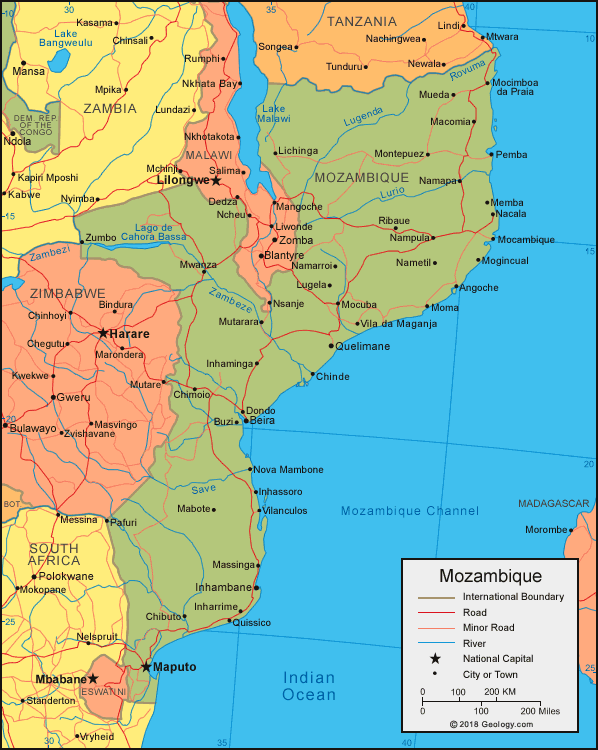
I have decided to fly to Mozambique, at a whopping US$290. The flight, to Nampula, takes 3hrs and covers a distance of 1500 miles. The alternative was the following. 


I would have taken a 12 hour bus journey from Dar es Salaam to Mtwara, at the very top of the map. I would have had to stay the night at Mtwara before getting a transport (in the back of a pick up truck) to the border at 3.00am. At the border I'd have to pay an exit fee from Tanzania of around US$5. I would then board a dugout canoe on the banks of the crocodile-infested Rovuma river for an initial fee of Mtc300 (around US$10). The boat trip takes around four hours. Except after about two hours the boat is stopped, the crew approach you and demand anywhere between Mtc3000, equivalent to $100 or they take you no further. If you refuse they attempt to take some of your possessions as substitute payment. 

Upon reaching the Mozambique border (if you do), there is no way of getting a visa at the border post. It has to be prearranged in Dar es Salaam, a process which takes 5 days and costs $50, twice the amount it would when bought at any airports. The immigration officers at the border also look for 'gifts' to ease your crossing. 

Once through the border it is back into a pickup (the back of one) for a further drive to Mocimboa da Praia, which should be reached by nightfall. From there it is a further three days travelling to Pemba. And then another day to Nampula, during which accomodation and transport costs would total at least $40 per day. 

So, this route would have taken six days, cost $300 and would probably have been highly unpleasant. Therefore I am taking a plane for three hours at a cost of $290 and should be virtually hassle-free (though I am travelling with Mozambique Airlines).

Therefore rather than referring to myself as a Beaten Man, I am preferring the term 'pragmatist' at the moment. Though we shall see how things work out. 

Anyway on to more interesting things. Spot the odd one out: Robert Mugabe, Nelson Mandela, Barack Obama, Wayne Looney. Got it? It's actually Mandela. The other three are national heroes here. 

I was in the supermarket earlier where there were Obama notebooks and pencils for sale (I do wish it was safe enough to carry my camera around here, then I could take some snaps. I also wish I hadn't lost the lead to my camera, so on taking these pictures I could upload them. But that's not the issue). Whilst on the streets every man and his dog has a fake united shirt on with 'Rooney' on the back - though they still insist on pronouncing it 'Looney' - they've probably been reading the News of the World. Oh wait. the News of the World doesn't exist anymore.

On a side note, what is happening in the UK in my absence? That great bastion of the working class media has gone under, people are rioting all over the place and Red Bull haven't won any of the last three Grand Prix. The world has turned upside down. Although one thing remains constant (and probably will): my parents are still spending their lives going out to dinner and moaning about their children.

Anyway Obama and Rooney are heroes - we can see why: one gives hope to all local people here who perhaps haven't had the best education but still want to reach the top of their profession, despite their social background and place of birth, whilst the other became the first black President of the United States. But Mugabe? Why glorify a man who crippled and desecrated one of the most naturally beautiful nations on the planet? Because he defies the West. And despite western influences being everywhere (Barclays is the biggest bank here), people resent it. And so there is a Mugabe street in every major town, and there are even schools and public buildings named after him. Shame really.

One last thing I found out today: in an attempt to stay out of the argument over what to call the popular potato-based fried snacks of which Walkers/Lays are one example, the Tanzanians have gone for the word 'Crips'. They aren't chips, and they aren't crisps. They are crips. Now that is fence sitting for you. You wouldn't find that in France (where phonetically you would think crisps are called 'sheep').

So I'm saying goodbye to Tanzania. It should take me 2-3 weeks to get through Mozambique to Jo'burg, where I start the final leg of my trip, all the way round the Cape to a place we called 'Good Hope'. By that point I'll probably be busking on street corners (Kenny Rogers is really popular in South Africa you know) and sleeping in doorways due to lack of money. But hey, This Is Africa - anything is possible.