Monday, 29 August 2011

The Kingdom

How many virgins can you fit in one field? Well, according to the organisers of the Umhlanga Reed Dance Festival in The Kingdom of Swaziland, over 80,000. I don't know if there were actually 80,000 there, because I lost count after two hundred. But there were definitely lots of them there. In fact, there were virgins as far as the eye can see. And they were all half naked.


Now you might think that for a virile young man such as myself that this would be the perfect outing, especially with my camera in one hand and no chance of reprimand in the other. But I didn't really enjoy the ceremony. There were girls there as young as nine, and I'm not too comfortable around naked girls who haven't even reached their teens (or ones slightly older than that, to be honest). I took a few photos, obviously (rude not to), but these were from afar or behind wherever possible. Although the latter also brought some uncomfortable viewing.

The purpose of the festival is ostensibly to allow the King (the seemingly omnipotent ruler of Swaziland) to choose his next wife, so all the girls in the Kingdom who are yet to be tainted by manflesh come together and present themselves to the King. And he then choses one of them to join his harem. But to me this seemed a bit farcical.

I don't know how on earth he is supposed to choose one girl from among the masses spread out before him, and I also don't know how he is supposed to be certain that their maidenhead is still intact. It seems that this whole aspect of the festival is a bit artificial, and the lucky lady is chosen prior to the event. Instead, the event has come to be a time when the young girls of the nation come together to celebrate their virginity, which is supposed to be maintained until marriage.

They see this as culturally significant, but obviously from a Western observer of a country where the HIV infection rate is over 25% the fact that girls can be proud of not sleeping around should help to prevent the further spread of infection. How much effect their being proud actually has, no one can be sure, but every cultural aspect should help, as tradition is one of the most significant reasons for the astronomically high rate of HIV/AIDS.

However, just because I felt uncomfortable taking photos, it does not mean that others didn't. This was a tourist fest beyond my imagining, and it made me think of what it must have been like to stand in front of Buckingham Palace waiting to catch a glimpse of William and Kate (or 'Catherine' as she seems to be called now) having a cheeky smooch. Everyone literally fighing over the most opportune photo taking point, and those with the biggest cameras somehow thinking that gave them the right to be at the front of the crowd. 'Excuse me,' I said in response to one such excuse for a rather hard shove, 'but I am taking mental pictures.'

I do not like to stereotype nations or races, but there were two very prominent cultures on display in the tourist area of this spectacle: The Japanese and the Germans.

To be honest, I don't have a problem with the Japanese being there with their cameras. They make the best cameras and they take so many photos that they must be good at photography - and I suppose that is why all the official photographers hailed from the Orient.

But the Germans...grr...

As I say, I hate to stereotype nations - I have met some wonderful German people since being out here, some of my favourite, in fact. But I have also met some I absolutely detest. The kind that will get up at 5am to put their towel on a sun lounger by the swimming pool. They also think it is their god-given right to have exclusive access to the best viewpoints from which to stick an 8ft lense on the front of their semi-expensive SLR and take too many photos of a few virgins who just want the chance to be looked on by a fat man in a cape with some feathers in his hair (Mswati III, to you and me).

It wouldn't be so bad if they weren't all male and over fifty. When they decide to take a picture on 30x zoom of a twelve year old's breasts they have gone too far. And obviously I know exactly what they were taking pictures of, because they put their camera right in front of my eyes whilst taking the picture, so I am unable to anything else but their perverted media.

But this failed to ruin Swaziland. The people are lovely, the public transport incomprehensible (it costs 4 Rand - 35p - to go anywhere, be it 200m or 10km) and the scenery is fantastic. Nevertheless, my stop there had to be fleeting, because aside from watching parading virgins, there isn't all that much to do.

So I decided to come to Jo'burg. Which is fine. It is perfectly safe if you stick to well populated areas, travel around in groups and make sure you are in your accommodation before dark.

However, by the time my bus left Swaziland it was 1.30pm, and it is a 5-6 hour journey to Jo'burg. So naturally, I arrived in darkness, on my own, looking for a hostel in a rather deserted part of town. I have been in such situations before, and they were fine - but they were not in the city with the highest violent crime rate in the world.

Nevertheless, I still felt able to get annoyed at the taxi driver when he overcharged me (you wouldn't pay a fiver for a five minute taxi ride even in London), so perhaps that gusto saw me through to safety. Although tomorrow I'm off to stay in Soweto for a while. Heard of it? Arguably the place where they hate white people the most in the entire world. Lucky I'm slightly tanned then - I should be fine.

Saturday, 27 August 2011

Civilisation

I like being in a country that works. When I say that, I don’t mean to condescend the other countries I have been to. They all work too – in a fashion.  Things just take a bit longer, they aren’t as high quality, and normally end up costing about fifty per cent more than you thought. But then that was Africa. This is not.

Obviously the main difference between South Africa and the likes of Mozambique, Malawi and Tanzania is the number of English speakers and, to be more blunt about it, white people. Now I have seen enough of the ingenuity, practicality and pragmatism of the Bantu people (black Africans) to know that they are by no means unintelligent or uneducated, and so I am slightly puzzled by why South Africa is so much richer, more developed and civilised then the rest of Africa. 

But maybe it isn’t any of those things – maybe it just seems like this to me because South Africa seems more like Western Europe, and so I associate it with modernisation and development. Maybe the other nations are at a similar level of social evolution, they have just taken a different path. And maybe the white population of South Africa, through holding the vast majority of the wealth, is holding South Africa back, making it try and become the England of Africa (Namibia is Wales, Botswana is Scotland and Zambia/Zimbabwe are Northern Ireland and Ireland, in case you were wondering. Oh and Lesotho is the Isle of Man and Swaziland is Jersey). Africa should perhaps find its own path, away from a Western-imposed (the likes of Anglo American and BAT run things here) model of development.

That said, I like going into a shop and knowing how much something is going to cost. I like having electricity twenty-four hours a day, and hot water too. I like a fourteen seater bus being for fourteen people (even if it is being driven by a drunk Aretha Franklin fan), and I like not having to pay through the nose for a visa.
More importantly, I like the countryside. The palm-fringed beaches of Mozambique are far behind. Mpumalunga (seriously, that’s what it’s called) in the north of the country is filled with rolling hills, dense vegetation and stunning streams, rivers and waterfalls. This travelling lark works on recommendation, and I was recommended mountain biking in the Blyde River Canyon, up to somewhere called ‘God’s Window’, which gave me the chance to experience this first hand.

‘God’s Window’ – that’s a bit of a pretentious name isn’t it? I thought that myself, until I saw it. There are actually two God’s Windows – the less good one close to the road with all the tourists (including the local kids on a school trip who feel the need to stand at one of the world’s most outstanding areas of natural beauty and blast out a Pitbull-Soldier Boy remix from their cellphones), and then the one that you have to cycle for two hours up an old logging track to get to. I did both. Guess which was better?

The first one is just a viewpoint, overlooking about fifty kilometres of wonderful countryside. A slight haze hangs over the valley most days, but it just adds to the splendour of the sight.


However, the second one – the ‘real’ God’s Window to the locals – is actually a large, upright flat rock with a square hole in. Like an actual window. Look through it and the view is even better. Perhaps because it is higher, perhaps because it is framed by this natural feature. Perhaps because you have had to sweat like a pig in order to get there, and when you do there is no one else in sight.


I think I spent about an hour there, just listening to a few tunes on the old iPod (which is working well, in case you were concerned) – Sigur Ros if I remember rightly, eating a tuna pasta salad I had concocted the night before (no, I haven’t lost my culinary skills yet), and generally enjoying being alone. I hope God wasn’t trying to look through it at that point, because he would have had to peer over my shoulder.

Anyway after that I went kloofing, which the Afrikaans version of canyoning. Which means that it is generally more aggressive (like all the Afrkiaaners) and that you don’t get a choice as to whether you are jumping into the waterfall – because otherwise their big dogs just chase you in. Still, once in the waterfall, it’s nice to be there. The Afrikaaners also enjoy taking pictures of you whilst looking ridiculous, and then commenting on the picture in Afrikaans which they know you can’t understand. Still, a nice day out.

And now I am in Swaziland, waiting for the Umhlanga, the Reed Dance Festival. It is where 60,000+ virgins in the kingdom come together to dance with reeds on in front of the King, and then he chooses one of them (the youngest are twelve years old) to join his harem. Sounds quite spectacular – we shall have to wait and see.

In the mean time, I am in the nicest hostel in the world. No jokes, this place is stunning. And it only costs £9 a night. Check out the view from my window - not bad, not bad at all.


Saturday, 20 August 2011

Into The Light

More paradise here - Tofo Beach, Mozambique. I think I'm going to make this the last white sand beach with lovely warm water and palm trees for a while, because they are getting quite boring. And I haven't seen an elephant for a couple of weeks so I think it's time to hit Kruger National Park.

In the mean time, I wanted to comment on a couple of milestones. Whilst on the aforementioned hellish journey there was a brief moment which was rather nice, when we spent half an hour or so travelling through the Zambezi Delta. And then got to a massive bridge over a massive river with the sign 'Zambezi' written on it. This is significant because the first time I crossed such a bridge over this same river was in Namibia - six countries ago.

Since then I have encountered the Zambezi in a number of ways and names - getting smashed and dancing like a berk on the banks of the Okovango, cruising down the Chobe watching massive herds of elephants, jumping off a bridge with just a rope tied round my ankles over Vic Falls, white water rafting on the Zambezi rapids, and then finally driving over it in a bus that stank of vomit as the sun was setting. Quite a journey - and I didn't get bitten by a crocodile once.

The next milestone to comment on concerns two possessions of mine that I did not think would make it this far. One is my yellow fever certificate (known as my 'Namibian Health Passport'), the other is my Andrex tri-ply.

When I get home I will take a picture of my yellow fever certificate. The only reason I can actually give for how I have been allowed into so many countries with it is that this is Africa. Where they seem to accept a photocopied dog-eared piece of paper with the words 'yellow fever' written in a doctor's illegible scrawl followed by his signature, which has got rumpled, crumpled and dampened more times than I can remember. But it's ok - because it has the words 'Namibian Health Passport' written on the front. So it must be legitimate....because Namibia has such a strong reputation in the field of healthcare.

So why NHP over NHS? Well, I didn't really plan to go to Tanzania. And then it kind of happened, but Tanzania has yellow fever, and I didn't have a vaccination - so I did what every intelligent, health conscious, western traveller would do: I rolled into the nearest medical centre and asked for an injection. Only this one happened to be quite close to the Namibian desert. In fact, you could go as far to say that the centre was in the middle of it. Still, the fact that after having the jab in my derriere the fact that I couldn't sit down for an evening didn't bother me too much. This was because I had the magic piece of paper that would get me into every further country without any trouble (as long as it was accompanied by a number of small green pieces of paper with a picture of a certain federal reserve on the back).

And now my yellow fever certificate is more of a morale booster for me than haribo or dairy milk could ever be. Crossing African borders can often be stressful, especially if it is into Mozambique, when the man decides that on that particular day a visa costs US$80. At which point I protest, saying that the embassy told me it was only $25, at which point two of his colleagues look up at me and the American bloke behind me whispers in my ear, 'Just pay it man, it's not worth it.' I was unhappy, but was sufficiently buoyed by the way in which they accepted my yellow fever certificate without question that I soon got over it.

Obviously the Namibian Health Passport has its sternest test to come, when I try to get into South Africa in a few days time - South Africa being a proper country and all.

Now, onto the Andrex Tri-Ply.

In terms of toilets, Africa is better than I was expecting. Having travelled in Asia, where the toilet seat is the air immediately above a hole and the toilet paper (henceforth known as bog roll) is your left hand, I was expecting similar standards here. However, it seems Cecil Rhodes did a better job than Robert Clive in instilling western standards and as a result most toilets have seats, flushes and, often, bog roll.

It is really only the worst toilets which don't have any proximate wiping device, and it is in these situations that many might despair. They might think of holding it in, they might think of just going for a #1 - they might even come over all asian if desperation has reached such a level. But not me.

It is at times like these I return to my bag, open the main compartment, thrust with one arm all the way to the bottom, past dirty boxer shorts and stained shirts to a small airtight, watertight, protective bag at the bottom. I can feel its softness before I even see it. Out it comes, slightly crushed, slightly ruffled, but when I take it out of its bag and unroll a few sheets it is there in its full glory. Cotton white, triple ply, extra soft.

I return to the questionable toilet with a spring in my step, knowing that however bad the start and the middle of the process is, there is always going to be a happy ending. Andrex Tri-Ply, I salute you.

If I was a psychologist reading this I would probably identify the tri-ply and NHP as tangible coping mechanisms used to deal with uncomfortable situations. And I would agree. Without them, I would be a lot less happy.

Had the nicest meal so far in Africa yesterday - it was cooked by a Frenchman. Rhodes didn't do too well on food, to be honest, but I think he was more concerned with diamonds and continental power struggles than cuisine - but still, he could have tried. No more prawns after tomorrow, but elephant should be back on the menu before too long. My favourite.

Thursday, 18 August 2011

A Journey To Remember...Or To Forget

As far as I am concerned, I am good at two things in this world:
1): Talking endlessly about nothing in particular
2): Completing long journeys without too much bother

Now I have tried to isolate the reasons behind the second of those two major skills, and have narrowed it down to three parts:
1) Having the ability to daydream for hours on end
2) Being able to sleep anywhere, under any circumstances
3) Being at my most comfortable in a situation where there is no possibility of being able to work, so I don't feel guilty about not working

I would need all these skills in abundance on the journey I have just been on. I would say it is the worst bus journey I have just been on. And I should know - I was on it. It was so horrific for the following reasons:
- The 'organisation'
- The 'coach'
- Fellow passengers
- The smell
- The roads
- The catering
- The length of the journey

The 'Organisation'
Well, there wasn't really any. As far as I can tell it was two blokes (a conductor and a driver) who owned a bus and had decided to drive it down to Maputo for a laugh, just taking some people along with them for the fun of it. There was seat allocation, at least. Well I was pointed in the direction of the last seat without anyone in it, which to be honest I would have taken anyway, but it was nice to be directed to my seat all the same. And despite initially being told it would cost me 2000 Meticais, three hours into the journey the conductor came round and demanded 2500. Which made me really happy, especially given that by that time I had been able to experience a little of what I would go through for the following 25 hours.

The 'Coach'
I was encouraged by a notice just inside the door saying '65 Lugares', which suggested they would be limiting the number of people on the bus. Not so. I counted 109 people at peak capacity, which, let me tell you, is a bit of a squeeze. Especially as I was seemingly the only person to put my luggage in the hold, everyone else having taken their suitcases on board with them - and with hindsight, I made the right choice. The seats also deserve a comment. Basically a park bench would be a useful comparison, except a park bench doesn't bounce along potholed roads for hours on end. The phrase 'numb bum' sprung to mind often throughout the trip. Ventilation was also limited - mainly because it is winter here and my fellow passengers were cold. I am pretty sure it never dropped below 25 degrees on the trip, but they were still in hats, scarves and gloves. I was sitting there in shorts and t shirt looking at one particular Michelin man thinking, 'you ought to try going to Wales in February mate.'

Fellow Passengers
Aside from not opening the windows, there were a number of other things that made them not the most pleasant people to travel with. Like those on the bus (at least 10, I reckon) with tuberculosis. Who didn't feel the need to cover their mouths when they coughed. Lucky I had my multivits - otherwise I would be in bed, ill right now. Obviously if you have tb and you don't cover your mouth, why bother if you are sneezing? And the number of mothers with babies was too many. I was sandwiched between 4 mothers and six infants. All of whom were still at the 'breast-feeding, soiling oneself' stage. I am growing more comfortable with the nursing of children, but it wasn't easy to avert my eyes when there were suckling children in 360 degrees of my vision. And these kids loved to make a racket. And throw food everywhere. And just fall over everywhere.

The Smell
If this was Wikipedia, there would be a message here saying, 'It has been suggested that this article be merged with 'Fellow Passengers'', but it was such an important issue that it needs its own heading. I'm just going to tell you the kinds of smell, and you can fill in the rest of the description yourself:
- Urine
- Faeces
- Vomit
- Sweat
- Africa

The Roads
We moan about the M25. Mozambique only has 1 road, the N1, and they can't even maintain that properly. Not that they aren't trying - we had to take a sand track for at least 3 hours because there were road works, which have apparently been going on for 12 years - and we complain that the M1 roadworks are taking too long. Yeah, the roads weren't ideal, but not the worst in Africa, it's just I've never spent as long on them in one go before this.

The Catering
Obviously there were multiple opportunities to get decent food en route. Oh no wait...there weren't. Stopping at junctions we had the opportunity to buy sandy bread rolls through the window, or if we fancied a live chicken. It got to the stage, having eaten only a pack of biscuits and a banana in 20 hours that I did consider buying, then plucking a chicken in the bus (there were worse things floating around than chicken feathers by that point), but I then realised I'd left my rotisserie and coals in the hold, so there was no way of cooking it. Damn.

The Length of the Journey
This was the only real reason why the other issues were issues. I could have endured it quite happily for a few hours, but twenty-eight is just a bit too long to sit next to a man who clearly hasn't washed in weeks.


Having said all this, I was asleep for twelve hours, daydreaming for five and read my book for quite a few hours too, so I was able to get through it. And now I am in a nice hostel on a very nice beach with some cool people, listening to Bob Marley and eating prawns, so the journey was just a means to an end. Although I did have to spend another seven hours getting a ferry and another bus before I reached here. And it is now raining. But this is Africa - expect the unexpected. Except I was expecting much worse, so I'm actually quite pleased.

Monday, 15 August 2011

Paradise Lost

No I am not comparing my writing ability to that of Milton, I just thought that this was quite an appropriate title. You see, my situation has literally gone from the sublime to the ridiculous.

When I asked someone before coming to Mozambique what there was to do here, the answer was, 'go to the beach, drink beer and eat prawns.' To which I replied, 'Isn't there anything else to do?' And his response was, 'Na mate, everywhere else is gash.'

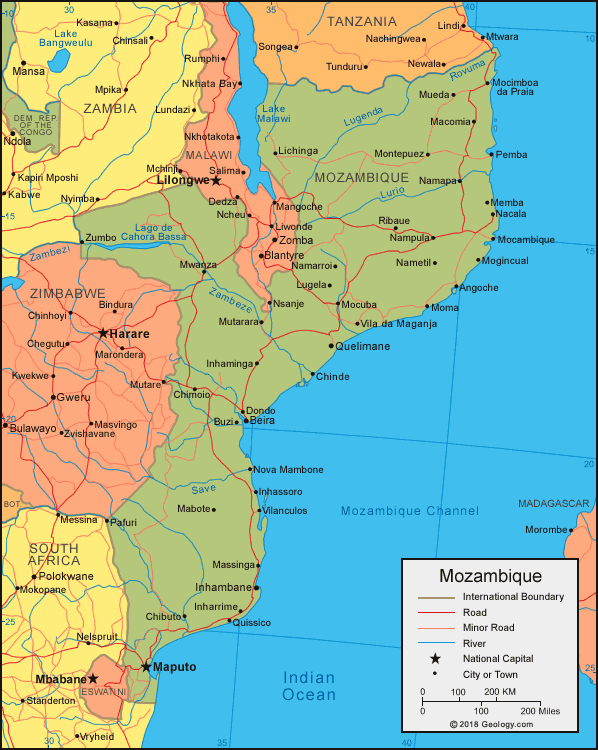
And he was right. I am stuck in the northern capital, Nampula, waiting for a bus (which leaves every Tuesday, Thursday or somewhere in between) that goes all the way to Maputo. Having originally planned to stay at numerous places down the Mozambique coastline for a day or two, this seems like a drastic move. But Mozambique is ridiculously expensive, and away from the coast is not particularly nice. It is western prices for African goods here (they still sell Sega Megadrives in the shops), so I am getting down to the competitive end of the country as soon as possible. 26 hours and 2000 Meticais (about US$100) on the bus should see me in Tofo Beach - the backpackers choice for Mozambique.

Not that being here hasn't been an experience. My hotel, for example, is top notch. At Mtc800 per night ($30) you would expect a certain amount of luxury in Africa. But ask me how many of the toilets have toilet seats in the hotel. Err...well I counted half; as in one toilet had half a toilet seat. I also optimistically waited for ten minutes for the hot water pressure in the shower to increase, before realising it was only faintly warm at the beginning because it had been sitting stagnant in the pipes for a few hours beforehand.

I suppose I am expecting too much from a Pensao (cheapest form of hotel) above a Chinese restaurant. I know from my own experience of Chinese run establishments in the UK that hygiene is often not given the highest priority, and this is no different. They also don't seem to serve crispy shredded beef in Mozambican Chinese restaurants, which I was ready to accept - but when the news came through that they don't have prawn crackers either, I nearly hit the roof. This must be the country - apart from Scotland, perhaps - with the most prawns per capita in the world. Yet no prawn crackers! Devastating.

However, I wasn't that devstated, because my apetite has not been what it used to be in recent days. This is because I have had my first onset of illness since coming to this incredible continent. It has only taken eight countries, but finally I have spent two nights unable to sleep whilst things of varying vile colours exit from  numerous parts of my body at various speeds and frequencies. Obviously a hotel with half a toilet seat and a dirty restaurant is the perfect place to be during such a period, but as I always say: beggars can't be choosers. I've been in worse situations before, and I am sure there will be many more such times to come.

I suppose it is just lucky that I have such an awesome command of the Portugese language. Oh no, wait...I  don't. In actual fact my Portuges is just French words slightly Italianised with English used to fill the spaces. As a result it does not work. Which is another reason why I'm heading to the south of the country so quickly, where people speak slightly more English (due to having to deal with obnoxious Afkrikaaners every holidy season). It literally took thirty minutes to find out what time my bus is leaving tomorrow. And I am still not quite sure, so I am going to roll up at 2.00am and just hope for the best (I think it leaves at 3 - but this is TIA, so who knows).

One last thing to mention is the most common good being sold here. It is in fact live chickens. I assume that you cannot trust the quality or cleanliness of a chicken that has been slaughtered, plucked and trussed and as a result people prefer to see the chicken whilst it is alive before making a judgement on whether to buy it or not. It is also a better way of keeping it fresh. They might also use the feathers for filling cushions, and the head to put on a necklace or something. Either way, I don't appreciate live chickens being thrust in my face when I'm trying to go to the ATM in the morning (although it is probably more agreeable than being offered weed whilst making a similar trip in Zimbabwe). Fortunately my Portugese does extend to,  'Nao, obrigado,' which means, 'No, thank you,' so am able to make it clear that I have already got my meat for this week's Sunday roast. 

This booming trade in live chickens makes bus rides interesting though. It was rather like the scene near the start of Borat where he lets live chickens out of his suitcase on the New York subway - except it happened to me on a chapa meant for 15 people, so was rather more difficult to avoid these squawking monsters. Still, they were more pleasant company than the basket loads of stinking fish stacked everywhere on the first leg of the journey.

So twenty-six hours, 2500km on a bus and I should be rediscovering paradise. But as TIA I'm not expecting it to go that smoothly. I'm going to call it thirty-five hours and a broken wrist and then I think I'll be closer to the truth. Aim low and you'll never be disappointed.

Saturday, 13 August 2011

Another Day In Paradise

And that is where the Phil Collins references stop. Because despite the prolific ability of the former Genesis drummer (as a recording artist - definitely not as a live performer), he could not even begin to do justice to my experiences of yesterday. In fact the only song that even comes close to the same level of beauty as the Ilha de Mocambique is this: http://www.youtube.com/watch?v=DRsnMGA5H1k&feature=related

It is not the easiest journey to Mozambique Island - seven and a half hours to cover 180km is never fun, especially in a chapa (small local 16 seater minibus with 30 people in) when the heat never falls below 25 degrees. But it was worth it. 

The island is the oldest town in Mozambique, the former Portugese capital and filled with grandiose colonial architecture which is now, of course, all falling down. And to be honest, when I was unceremoniously dumped in the middle of town next to a pile of rubbish by a dilapidated 'hospital' I was hardly too enamoured by the place. But the good old Lonely Planet did its job and directed me to arguably the nicest guesthouse I have ever been to.

You walk in the front door, through the kitchen outside, where the dining/living area is an open courtyard in the shade of palm trees, entirely insulated from the outside world - a kind of vortex of tranquility in an otherwise bustling settlement. It is presided over by an Afro-Portugese 'Mama' whose home cooking is arguably/definitely better than my own (certainly uses more local produce, anyway - her tomatoes come from her family's land, whereas the ones I use come from Turkey). And the landlord (don't know the Portugese word), Luis is a chain smoking fat man with a massive moustache who was kind enough to take us out on his boat yesterday morning.

Now I have been sailing a few times in my life. I'd almost go as far to say that I have probably been over a thousand times. Perhaps two thousand. And I have done so in some pretty cool places - but this was better than all of them.

The dhow was slightly worrying me at first, having a definite constant leak and the mast being made of three different pieces of wood lashed together with what looked like old pieces of washing line. But the old girl took to water like...well...a fish to water. Except it actually stayed on the surface, and must have been pushing five knots at points.

Anyway we sailed to paradise. I am so sure that we did a Pirates of the Caribbean-esq transfer into a different world because I have never seen anything quite like this.

A peninsula with the lush green of mangroves on one side, where tiny fish swim through the channels, crabs scurry along the sand and monkeys swing from the trees. Coconuts, cashews and bananas are literally about to fall from the tree they are so ripe for the picking. The sun is roasting but the cool sea breeze means it is never too hot, as you amble through this place where the small footprints of small children collecting local shellfish are the only reminder of any human presence.

It is at this point that I realise I'm not that far from home, after all. Because as we go to find the way into the oldest church (and probably oldest building) in Mozambique, the guardian appears. What are you expecting, a monk in brown robes? Or a nun at least? Afraid not. This bloke actually seems to have got lost on his way to St James's Park - why else would he be wearing a Newcastle shirt with 9 Shearer on the back? Didn't spoil the atmospshere though - it was still pretty special. I did slip in a cheeky 'Obrigado, Alan,' when we left though. He didn't understand.

Ten minutes more walking and we reach the other side of the peninsula - the beach. So how clear is the water in your local authority swimming pool? Not as clear as this, I'll bet. It wasn't even blue - it was transparent. And I thought the sand was limestone dust, it was so white. And then to be met on the beach by a waiter giving us complimentary drinks, because Luis's brother in law owns the five star resort which the beach is part of, was not bad either.

I could have stayed days at this place, but we had to get back before dark. Only trouble was, we got waylaid on the way back by the need to drink some coconut milk and eat some fresh pineapple, so the sun was fast setting by the time we got back to the boat.

Which made it even more special. African sunset #45 was the best. Better even than that Northern Lights like haze over the Etosha Pan in Namibia, prettier even than on a river cruise down the Chobe in Botswana whilst half cut. Because this sunset was on the water, sailing along with no noise but the crunch of waves on the bow, the sun setting on one side whilst the full moon rose on the other. Two reflections over the water, me in between. I had a cheeky moment then - one of my life reflection times, after which I glanced left, at the setting sun, and then right, at the shining moon, and then said aloud, 'could be worse.'

In fact, I don't think it could have been better. Despite being turbo expensive, Mozambique is everything it promised. Definitely glad I didn't fly straight to Jo'burg now.

Wednesday, 10 August 2011

Beaten Paths Are For Beaten Men

And I'm taking a beaten path. So does that make me a beaten man? I would hope not. Let me explain.

I have decided to fly to Mozambique, at a whopping US$290. The flight, to Nampula, takes 3hrs and covers a distance of 1500 miles. The alternative was the following. 


I would have taken a 12 hour bus journey from Dar es Salaam to Mtwara, at the very top of the map. I would have had to stay the night at Mtwara before getting a transport (in the back of a pick up truck) to the border at 3.00am. At the border I'd have to pay an exit fee from Tanzania of around US$5. I would then board a dugout canoe on the banks of the crocodile-infested Rovuma river for an initial fee of Mtc300 (around US$10). The boat trip takes around four hours. Except after about two hours the boat is stopped, the crew approach you and demand anywhere between Mtc3000, equivalent to $100 or they take you no further. If you refuse they attempt to take some of your possessions as substitute payment. 

Upon reaching the Mozambique border (if you do), there is no way of getting a visa at the border post. It has to be prearranged in Dar es Salaam, a process which takes 5 days and costs $50, twice the amount it would when bought at any airports. The immigration officers at the border also look for 'gifts' to ease your crossing. 

Once through the border it is back into a pickup (the back of one) for a further drive to Mocimboa da Praia, which should be reached by nightfall. From there it is a further three days travelling to Pemba. And then another day to Nampula, during which accomodation and transport costs would total at least $40 per day. 

So, this route would have taken six days, cost $300 and would probably have been highly unpleasant. Therefore I am taking a plane for three hours at a cost of $290 and should be virtually hassle-free (though I am travelling with Mozambique Airlines).

Therefore rather than referring to myself as a Beaten Man, I am preferring the term 'pragmatist' at the moment. Though we shall see how things work out. 

Anyway on to more interesting things. Spot the odd one out: Robert Mugabe, Nelson Mandela, Barack Obama, Wayne Looney. Got it? It's actually Mandela. The other three are national heroes here. 

I was in the supermarket earlier where there were Obama notebooks and pencils for sale (I do wish it was safe enough to carry my camera around here, then I could take some snaps. I also wish I hadn't lost the lead to my camera, so on taking these pictures I could upload them. But that's not the issue). Whilst on the streets every man and his dog has a fake united shirt on with 'Rooney' on the back - though they still insist on pronouncing it 'Looney' - they've probably been reading the News of the World. Oh wait. the News of the World doesn't exist anymore.

On a side note, what is happening in the UK in my absence? That great bastion of the working class media has gone under, people are rioting all over the place and Red Bull haven't won any of the last three Grand Prix. The world has turned upside down. Although one thing remains constant (and probably will): my parents are still spending their lives going out to dinner and moaning about their children.

Anyway Obama and Rooney are heroes - we can see why: one gives hope to all local people here who perhaps haven't had the best education but still want to reach the top of their profession, despite their social background and place of birth, whilst the other became the first black President of the United States. But Mugabe? Why glorify a man who crippled and desecrated one of the most naturally beautiful nations on the planet? Because he defies the West. And despite western influences being everywhere (Barclays is the biggest bank here), people resent it. And so there is a Mugabe street in every major town, and there are even schools and public buildings named after him. Shame really.

One last thing I found out today: in an attempt to stay out of the argument over what to call the popular potato-based fried snacks of which Walkers/Lays are one example, the Tanzanians have gone for the word 'Crips'. They aren't chips, and they aren't crisps. They are crips. Now that is fence sitting for you. You wouldn't find that in France (where phonetically you would think crisps are called 'sheep').

So I'm saying goodbye to Tanzania. It should take me 2-3 weeks to get through Mozambique to Jo'burg, where I start the final leg of my trip, all the way round the Cape to a place we called 'Good Hope'. By that point I'll probably be busking on street corners (Kenny Rogers is really popular in South Africa you know) and sleeping in doorways due to lack of money. But hey, This Is Africa - anything is possible.

Monday, 8 August 2011

Cultural Differences, Geographical Differences, Same Old Africa

'What time will it be open in the morning?'
Muttered conversation to friend in Swahili, 'Tri,' he says, holding up three fingers.
'3? In the morning?'
'Yes, rafiki.'

So an internet cafe that opens at 3 in the morning. Yes I was confused. But then I got back to my hotel and read the notice on my door which said, 'Check out by 4.00 morning.' Something isn't right here. Are we on GMT or something?

No. We aren't. Time actually starts here (Dar-es-Salaam, Tanzania) at 6.00am, so 3.00 actually means nine in the morning, which is a far more acceptable time for an internet cafe to open than at normal night club kicking out time.

Not that there are any night clubs in Dar-es-Salaam. It's Ramadan at the moment, so all anyone does at night is eat. Which means eating during the day is very difficult, with not even a Mandazi (savoury doughnut) for sale at the side of the road. And the moment you start hitting the shops, white man (mzungu) prices start crippling the wallet. Thank the lord for Tanzanian Subway. At half the western price for a foot long Italian BMT, lunch and dinner are sorted. And at the well-reputed (not) Dar-es-Salaam YMCA, breakfast is included, which consists of an omlette (where at least half an egg is used per person, the rest of which is made up with watery milk) on African toast (bread left out in the sun), enough to see anyone through until 10.00am (or 4.00 morning as us Swahili speakers call it).

At first I thought it odd when people started calling 'Rafiki' and 'Hakuna Matata' at me from across the street - in the same way they like to call out, 'my friend, you know Manchester? Wayne Looney?' (Africans confuse their 'L' and 'R' sounds). I didn't know the Lion King was that popular in East Africa, but luckily I was readily prepared for this eventuality, with the Original West End Cast Recording of the Lion King stage show on my iPod (which doesn't get that much use anymore, due to prior explained reasons). Thus as soon as someone called to me 'Hukuna Matata', I was able to reply, 'What a wonderful phrase', expecting the addresser to respond, 'it means no worries, for the rest of your days.' But he didn't. Because 'hakuna matata' did not originate in the Lion King - it is actually Swahili for 'no worries' - hence the song.

In the same way 'Rafiki' means 'friend,' Simba means lion and Pumba means warthog. Although apparently Scar just means evil regicidal lion with a black mane who only wants to increase the infant mortality rate among lions in the East African Savannah.

Anyway armed with my vast Swahili vocabulary I have spent my entire time here in...posh western hotels. Definitely the way forward. Being white means I am instantly trusted (I sometimes wonder what the security people would do if they worked in Liverpool), so I can just chill out in posh cafes and bars watching sports, drinking tea and scheming on how I can get into the gym without being a guest. 

I have another two days to do so though, seeing as Ramadan, the weekend and then a public holiday means I have been able to sort out nothing for Mozambique, except the decision to fly instead of going the overland route. Apparently during the four hour river crossing from Tanzania, the majority of time mzungus (white people) are stopped half way and told to pay ten times the original price otherwise they will not be taken any further. I have no desire to be in such a situation, so instead I am flying to a place 10km from a beach resort, where I hope prawns, surf and cool people will be in abundance. 

Africa is the most varied place I have been to, but some things never change, and bit by bit I am learning to deal with them.

Friday, 5 August 2011

This Is TIA

Grammatical error, I know, but then - this is TIA. Where people are more concerned with where the next meal is coming from than speaking correctly. So when someone is telling you where the 'rowntree' is, he is not informing you of the location of the production facility of a popular fruit-based sugar-coated sweet, he is actually directing you to the place where you can wash clothes.

So seven countries in five weeks means more money spent on visas than curios, but it does mean that I have visited more nations in my life than I have had birthdays, which I am assured is essential. Looking back on the last five weeks, there are a few salient issues which have had a significant bearing on every situation, which I would now like to discuss.

1) The breaking of my iPod charger
This was devastating. Needing music to function, getting three days into my trip and finding the $3 ebay special 'works with all Apple products' mains charger did not actually work has created numerous problems.

Problem #1 - I can't charge my iPod. Which means that I have to borrow off other people. "Well everybody has Apple products these days, there must be tonnes kicking about," I hear you cry. But alas! Being the USSR of the technology of the world that they are, I can just imagine the software engineers at Apple chuckling to themselves every time someone experiences the dreaded, 'charging is not supported with this accessory' message, because different generation chargers are required for different generation products. How infuriating. 

But as it just so happens, I have tracked down the one charger which works, and was actually bought from a market on the outskirts of Santiago, Chile, for less than $2. But other people need to use it, and Africa isn't famous for the reliability or availability of power, so I'm lucky if I get music once every three days.

And it has changed social dynamics. I am forced to sing my own music now, but as the only song I can really always remember is 'The Gambler' by Kenny Rogers, people are growing tired of my casino-based advice given in musical form, and I am quite sure they know when to hold them - and when to fold them.

Student: "Why haven't you bought an iPod charger in one of the cities you have been through?" (read Gandhi's Hind Swaraj)
Teacher: Essentially, you can't buy an iPod charger in Africa. Now this perplexed, puzzled and baffled me until I had a sudden epiphany a couple of days ago. I couldn't understand why it was impossible to buy an iPod charger anywhere - but then I realised: they don't have iPods. Why would they sell chargers for something people don't have? Now all the funny looks I got, when spending the customary five minutes explaining the item I was after, make sense. They probably didn't even know what an iPod is. 

So it looks like Apple's hugely successful marketing scheme isn't as ubiquitous as first thought. I mean - who has heard of Steve Jobs on the banks of Lake Malawi? Not Vegemite, nor Captain Morgan, or even Mr Fantastic (all real people, I assure you). Apple need to work harder on the sub-Saharan African market - Coca Cola, Vodafone and Orange have got it down. Whereas Apple - you have let me down. Sort it out.


Anyway I have spent far too long dealing with salient issue #1 to go onto #2 (Tanzanian internet isn't the most reliable, so I am making hay while the sun shines), but I will give you a teaser: imagine close to $150 being spent on an inflatable sleeping mat to get punctured 2 days into a 35 day camping trip. Bet you're on the edge of your seat now. You'll have to wait for that one though.

Arguably more importantly, what have I been doing? Well, I have swam a lot, tanned a lot, subsequently burned a lot, and then resultantly drunk a lot (logical process, you see). Lake Malawi (means 'Lake of Stars') is pretty fab, could have stayed there for a month, but Tanzania beckoned (with it yet another $50 visa), and more importantly Zanzibar, where I am now. All I knew about Zanzibar before coming was it featuring in a popular song by Tenacious D, but now I know that Freddy Mercury was born here and that the Indian Ocean is quite warm. So a real voyage of cultural discovery this one. Plans for the next few days: beach, bar, snorkel, 2,000 mile bus journey down the east coast of Africa, eat, sleep, have a chat. All in a day's work for Dr Livingstone mark two (I'm too far north to call myself Cecil Rhodes any longer, so the Scottish Afrophile will have to do). Mozambique, here I come.